

Arts I Life
Photographing The Diaspora
In a new book, photojournalist Frederic Brenner focuses on Jews in exile.
JOE BERKOFSKY
Jewish Telegraphic Agency
ATN
9/26
2003
no
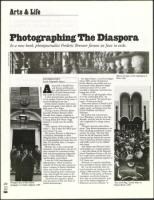
Portuguese Jews at Bevis Marks
Synagogue, in London, England 1992
man with a chiseled face
and Roman profile gazes
into the light amid a room-
ful of Greco-Roman busts
that could be of his ancestors.
A silver-haired Indian merchant sits
in his opulent Calcutta living room, a
servant holding his tea tray.
Jewish school students stand atop a
pyramid alongside a faux Sphinx and
palm trees in Las Vegas.
During a recent interview, photo-
journalist Frederic Brenner sifted
through these images, stopping to
point at one black-and-white image of
a young Italian Jew whose visage
seemed to morph into the marble
statues.
"This capacity of becoming the
Other — this is what the whole proj-
ect is about," he says.
The project Brenner is referring to
is Diaspora: Homelands in Exile
(HarperCollins; $100), a two-volume
set of photographs and essays due out
Sept. 30. In many ways, it encapsu-
lates his life's work.
Brenner, 44, is the controversial
chronicler of world Jewry who for 25
years roamed five continents living
with and photographing indigenous
Jews — from Azerbaijan to Yemen
and Brooklyn to Jerusalem.
It was his 1996 Jews/America/A
Representation, which included a
roomful of Groucho Marx imperson-
ators, a chapter of Harley-Davidson
riders and a table of semi-naked
women displaying their mastectomy
scars, that brought his name to the
coffee tables of many American Jews.
The book also exposed a debate
over the nature of this new form of
Jewish documentary.
Roberto di Segni in the Capitoleum in
For Egon Mayer, a noted sociologist Rome, Italy
whose 2001 survey of American
Jewish identity was widely seen as a
benchmark study, Brenner's highly
stylized portraits of U.S. Jews
recorded a whimsical, irreverent but
loving slice of life.
"These are not photographs either
of or for comfortable Jews," he
wrote, but unearth "the layered per-
sonae" of American Jewry.
There were photos of Jewish Civil
War enthusiasts, Jews at a Catskills
singles resort, and famous Jews like
Dustin Hoffman and Henry
Kissinger.
But author and commentator
Leon Wieseltier, writing in the New
Republic, said the Jews in the book
were "exploited in a cheap culture
game."
"Brenner's pictures adore them-
selves. They believe themsehres to be
fresh, shocking, paradoxical, contro-
versial," he wrote. "See how they
blow the lid off American Jewish
identity and go behind the conven-
tions of American Jewish existence
and boldly reveal it to be riddled"
with irony.
Still, Mayer says Brenner's latest
work surfaces at a crucial moment
— after the release of the National
Jewish Population Survey, a $6 mil-
lion study said to provide the most
comprehensive statistical snapshot of
U.S. Jewry ever.
Brenner's art captures something
facts and figures cannot, Mayer says.
He "can do artistically what we
social scientists are trying to do by
asking 1,000 questions," Mayer says.
Whether it's the photo of Russian
immigrant taxi drivers lining up
their cabs on Coney Island or a pic-
ture of the lesbian daughters of
"Jews with Hogs," Jewish bikers in
Holocaust survivors, Brenner "is
Miami Beach, 1994