

•
-- •
COND A R Y
WITNESSES
WSU professor explores
memory and meaning of World War II
through Holocaust imagery
created by post-war artists.
tkt fok$4 tk.441 1+
Nit*
Atlit%
oF do-st
I- mut, rot.k so,t
4t
cooS4 014 koM w14;:it,t4
..,..tes*,-40=
tikt.
f:s.sve..a
is#4.5 06.44tat *001, Q. fru
•
•
40.14
+Le
?ft, 4V,rsa sF 0,41`Z
40.1.* i.:>4;;.404.14,
.wt wkrol
e,r't 4 4..1
PAgt5 wAS
M144. Atm Mit. 11.tkl,se 41,"
'MR.(
VE. MAW rtr4,4, v- cA4i# ke
0.,t 44,3,
piiovotti 41.M.
sts tonts
ki44
tWt.
11..41 ozek4,41 *so feo4@ +yam'
, Ntr Ittk
.., 01est&
D
4it
1.41s 4
iAt%. tisk '010,"
lssi341 41r
tioe.,140,,ftittu.
*0.0.3 4,, Oa M 1
.(11, •,kt
14041 +4, &Alt Ai ax 3nktft44q..1
0. 4,4,01 4t- 54'4. Ar,t,...,4,1,
?wk. 4.44 foe Ossottuo>..ft.
tqAttifk;e4, 1 <MA. kola Ut43 tAt Oc.
CD wfr 4.4 •sh2as.tA.
Special to the Jewish News
A orgo.., koAtetvg ,00.4 031
kffais,
SUZANNE CHESSLER
rtSt,
.40ige
3,m1.$ asa ots i1/44..Sper.
(en*
ratamovo, Otrol votr4o,A...
3b1;,.. malt
a etipsoto wilt. 44..
3. 144, jeosf.41 issio 4.4voikes
4szki AkoN
tkt rokti 341. 41
3straw4
•
rot's: s, A>,ca a
fe.Aitft
wenxtel .fto&.
thi.'• 441:sta
.4A...icor.
4 ;t. s‘, 4t AAR) AV 1,W
A'4'14 ,4
•
;.•t9 fot.,4Zo) to /041. "1.k
Zes X44
5*.,1
A
oitd iwits.4 but Sus.r.4
e l'ohot ..4tres
rit at4co
3i r. 4r 4 'F tt
ftsek:f
'<{t
tia sta
kg
4'4.4a io,to ask thajo..•
is•4 mak soits.vta i too:
tiverf.m.slvA oss 41,et 54 4 .
goksaWim Ave
Sit
•
§4,
A ikkk
ftsk 104 4.0Aff,
t 1.4 4-0 4 ;:t1 t o,e,
t<likki-L kvs<1,:4.0( , ;Af+ors
•Ailtyitrj,
sa4t 4,.qe3:0=A
oat gin . .4tAt ts,"f § s4,ss4 .4ferti
3i0.1 in At ii 04,1e
41 - 140414
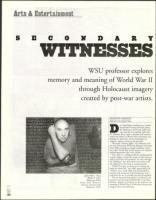
Jeffrey Wolin: 'Moses
Wloski, b. 1921,
Wolkowisk, White
Russia," from "Written in
Memory: Portraits of the
Holocaust," 1997.
12/13
2002
82
ora Apel began tracking new vocabu-
laries before writing_her book about
the Holocaust, but words really were
- not what she was seeking. Apel, the
W. Hawkins Ferry chair in modern and contem-
porary art history at Wayne State University, was
looking for distinctive visual vocabularies to
express a subject critical to her own life.
The result, Memory Effects: The Holocaust and
the Art of Secondary Witnessing (Rutgers University
Press; $28), introduces images created by artists
born after World War II and analyzes the individ-
ualized approaches they have chosen.
First, Apel, as a college professor teaching about
a select subject, reveals the nature of each artist as
well as each form of expression. Its only through
the "Epilogue" that the author's own story, and
the impetus for the book, is communicated.
"I think I've been working up to writing this
book my whole life," says Apel, approaching 50.
"When I was a small child, our household was
steeped with memories of the Holocaust, but it
took time for me to actually put that all together.
"For my doctoral dissertation, I worked on the
memory and meaning of World War I, and that
became a prelude to working on the memory and
meaning of World War II in the form of post-war
imagery about the Holocaust.