
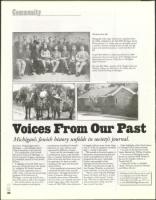

Clockwise from left:
Photograph of the tragic Greely Arctic expedition from
the 1880s, published in the Fall 2002 Michigan Jewish
History Journal. Lt. Greely, who was ultimately rescued,
is seated in the front row fourth from the left; and Sgt.
Israel, who died of starvation, is seated sixth from the
left.
Temple Beth Sholom in Ishpeming celebrates its 50th
anniversary this year and is part of the Michigan Jewish
History Journal's story on "Early Jews in Michigan's
Upper Peninsula."
Ben and Max Ellias, members of the Shabbat-observant
Palestine Colony near Bad Axe in the 1890s, from the
article "Jewish Farming in Michigan."
Photos courtesy the Jewish Historical Society of Michigan
k eisiatiaboie:
Voices From Our Past
Michigan's Jewish history unfolds in society's journal.
Jews have a long background in
Michigan — and Michigan Jewish
History documents it for posterity.
The publication of the Jewish
Historical Society of Michigan, is
North America's longest continuous-
ly published journal of local Jewish
history.
A highlight of the Fall 2002 issue is
the story of Edward Israel, who joined
Lt. Adolphus W. Greely's doomed
Arctic Ocean exploration team in
1881. Israel, a 22-year-old meteorology
graduate of the University of
Michigan, was the only Jewish mem-
ber of the team as well as the youngest.
The team's mission was part of an
elaborate endeavor involving the
11/22
2002
38
simultaneous recording of scientific
data from 12 arctic stations, each
sponsored by different a country.
Greely and his crew headed to the
northernmost station, Lady Franklin
Bay, in Canada's Northwest Territories.
Most of his men had little, if any, arc-
tic experience, let alone an under-
standing of the rigors and demands
ahead of them.
As the expedition's astronomer, Israel
conducted the bulk of the scientific
observations. He logged hundreds of
hours of research, delivering many
invaluable observations. Meanwhile,
the rest of the crew explored and chart-
ed the virgin region. After the harsh
winter of 1883-1884, when shipments
of supplies did not arrive, Israel, along
with 17 of the 25 expedition members,
died — mostly of starvation.
"We noticed an historical marker in
Kalamazoo commemorating Edward
Israel's accomplishments and were
intrigued by his story," said Judith
Cantor, past-president of the
Michigan Jewish Historical Society.
"We then were fortunate enough to
find Douglas Wamsley, an esteemed
arctic researcher, to write the account.
"This is a piece of Jewish Michigan
history few know, and that is, in part,
the mission of the journal," Cantor
said. "We want to make history alive
and exciting and, I think, that this
issue is one of our best."
Other highlights of the 42nd volume
of Michigan Jewish History include:
• an essay on the first Jews in the
Upper Potninsula by William Cohodas;
• an account of Michigan's Jewish
farmers by archivist Holly Teasdle of
the Leo M. Franklin Archives at
Temple Beth El;
• memorial articles on Rudolph
"Rudy" Newman, Seymour Gretchko
and Milton Marwil.
Michigan Jewish History can be read
in synagogue and secular libraries
or purchased through the society.
Call (248) 432-5600, ext. 2517, or
e-mail JHSofMichigan@msn.com