

Tettly A etti-i e
Thai
Open
'Food
Arts is Entertainment
Days
for Ltinctitik Dinne.t•
• SpecialitreW"\4.
clA As:
Voratike41,1 ■ 1ocycthe.s
APO,
Vegieict
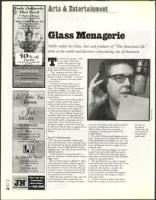
Glass Menagerie
Public radio's Ira Glass, host and producer of "This American Life,"
looks at the world and discovers a fascinating cast of characters.
Not good with any other offer
exp 6/30/02
•
T
he old Jewish joke goes, "How
do you make a Romanian
omelet? First steal two eggs."
So writes David Mamet in a
recent Time magazine profile of-National
Public Radio (NPR) host Ira Glass.
"Glass' programs sound as if their cre-
ator began by stealing a microphone,"
Mamet continues. "He finds — uncovers
— drama and humor in the most pedes-
trian of places."
Glass has re-invented radio as an art
form. His Public Radio International
show, This American Life (TAL), produced
in Chicago at WBEZ, is to radio what
Nichols and May (in the tradition of the
Jewish wedding jester) were to improvisa-
tional theater.
The documentary-style weekly program
chooses a subject and invites writers to
submit personal stories on that theme.
"Glass once did three hours on chickens.
The piece de resistance was a memoir on
an Israeli chicken kibbutz," says Mamet.
Glass, 43, pursues offhand remarks and
anecdotes, digs, prods and generally gets
"real" people to open up. He'll deconstruct
his Peabody Award-winning experiment in
radio verite' 4 p.m. Sunday, June 30, at
the Power Center in Lies, Sissies & Fiascoes:
An Afternoon With Ira Glass, a program that is
part of this year's Ann Arbor Summer
Festival.
Jewish Underpinnings
re p
SI
6/21
2002
72
Here's the new
Jewish News
phone number:
"TAL is this very emotional, idiosyncratic
show, and sometimes I try to tell people that I
do not feel that my job has changed from the
days when I was an NPR reporter covering
breaking news," says Glass in an interview for
Lifestyles magazine.
"I still document real moments that sur-
prise me, amuse me, and that gesture at some
bigger truth."
Born to Jewish parents in Baltimore, Glass,
while enjoying a cult-like celebrity, says he's
certainly less revered by his family. "They're
the only Jews in America who don't like pub-
lic radio," he says. "My parents have trouble
with me working in public broadcasting. It's
not successful in their world."
While the topics covered in TAL rarely have
Jewish content, it's been argued that "the
essence of the show — its scope and depth —
ossnu n ot Aq ol oq d
Total Bill
is Jewish, with Glass as the quintessential Jew:
neurotic, self-effacing, smart, funny — a
Woody Allen without the narcissism or
misogyny," according to an interview by
Abigail Pickus.
He calls his Baltimore upbringing quite sec-
ular, though rooted in Conservative tradition.
"My grandparents ate shellfish," he says. "I've
joked about this on the show, how my people
came off the boat and went straight for the
steamed crabs."
Glass rarely attends synagogue, yet keeps a
prayer book on his office shelf and opens it
often to the Vidui (the confessional prayers
most often recited during the High Holidays),
which, he says, speak to him.
"The problem I have as a Jew is I simply
don't believe in God, and I haven't since I was
a teenager," Glass told Pickus. But, she
reports, he does believe in morality, the
underpinning of Jewish teachings.
In an interview with Resonance magazine,
Glass enumerates three things we should
know about him:
1. He has worked in public radio all his
adult life, starting as a 19-year-old intern in
Ira Glass on
his parents:
"They're the only
Jews in America
who don't like .
public radio."