

4.
Healing
A new Center for
Jewish Healing
provides all Jews
with access to
spiritual healing.
SHARON LUCKERMAN
Staffriter
or heal people Jewishly, even if they're
not particularly connected to the Jewish
community
, We in the Detroit area have an abun-.
dance of providers and agencies that
apply a Jewish approach to healing," says
Rachel Yoskowitz, program director. Her
center, which is essentially a resource hub
located at JFS, received a two-year
$108,000 grant to do its work from the
Jewish Fund. (Proceeds from the sale of
the former Sinai Hospital are distributed
to the community through the Jewish
Fund.)
At the Center for Jewish Healing, "we
can connect people to the spiritual tools
and traditional sources — including
prayers, meditation and therapy — that
will help any Jewish person in times of
physical, emotional or spiritual need,"
Yoskowitz says.
"This means we can connect a Jewish
alcoholic to JACS (Jewish Alcoholics,
Chemically Dependent Persons &
Significant Others) instead of the
Christian-based Alcoholics Anonymous,"
she says. Or, a grieving individual who
has lost a spouse or a job can meet with a
therapist or rabbi trained in healing with
a "Jewish flavor.
For example, a JFS therapist encour-
aged her client, the woman now ready to
grieve for her abusive father, to light a
yahrtzeit candle, talk about him and,
with the therapist's support, recite the
Kaddish prayer. These were appropriate
ways for the Jewish daughter. to grieve,
heal and move on, Yoskowitz says.
The professional caring for his dying
father was lucky to meet with an
Orthodox rabbi trained as a hospice
chaplain, a person who had learned to
listen rather than pass judgment on peo-
ple in need.
"It's not easy for people who aren't
shul-goers and who suddenly have a need
for spirituality to knock on the syna-
gogue door and say, `OK, tell me about
it,'" says Rabbi E.B. "Bunny" Freedman,
director of the Jewish Hospice and
Chaplaincy Network.
Rabbi Freedman, who serves on the
board of the healing center, says he wants
every Jew to have Jewish spiritual
options. He's especially concerned about
providing Jewish healing for vulnerable
.
13
e is middle-aged and an
accomplished professional.
But his father is dying now,
and he doesn't know how to
comfort him. He hasn't given much
thought to what Judaism says about the
soul or an afterlife. The language of spiri-
tuality is unfamiliar to him.
She was unable to go to her father's
funeral because he had been abusive and
caused her great pain. When the painful
feelings wouldn't go away, she sought
help at Southfield-based Jewish Family
Service. Months later, she wants to find a
way to say goodbye to her father. But
how can she?
The two-month-old Center for Jewish
Healing offers a variety of services to help
,a 0ANA&MN
a.
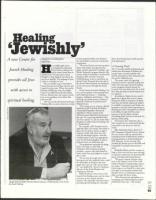
Temple Kol Ami Rabbi Norman Roman discusses a biblical psalm at the Center
for Jewish Healing.
Jews, those facing abuse, death, poverty
and dependence.
A Growing Trend
For 19 months, health professionals and
rabbis from all streams of Judaism dis-
cussed ways to connect people with
Jewish spirituality as they made plans for
the center, Yoskowitz says.
The center is part of a growing
national interest in spiritual healing, she
adds. Two years ago, 29 Jewish healing
center programs existed around the
country. Last year, there were 54, and all
but three are based in Jewish family serv-
ice agencies.
According to Yoskowitz, the center's
goals are to assure that no Jew is alone
during the difficult transitions of illness
and loss, that Jewish traditional wisdom
is available to consumers and health care
providers, and that Jewish approaches to
healing are used to strengthen an individ-
ual's ability to cope with the conse-
quences of serious illness and loss
(including death, job loss or the end of a
primary relationship.
The bottom line, Yoskowitz says, is
that "people [in our community] should
never have to be alone in a time of
need."
Ellen Yashinsky-Chute, director of
JFS Outpatient Clinical Services, already
has seen results with her patients after
attending several of Yoskowitz's monthly
training sessions on Jewish healing for
JFS clinicians. At one meeting, they
studied the Exodus story in the Bible and
compared it to people's personal jour-
neys.
Yashinsky-Chute used the concept to
help a client who had just come through
a traumatic experience and found herself
alone and depressed during Passover.
"We spent a session tying her situa-
tion to the Passover story so she could
think of herself as experiencing a person-
al exodus," Yashinsky-Chute says. Her
client began to see herself in a more posi-
tive light, as having been released into
freedom from an unfortunate experience.
She no longer felt like a victim.
"We're learning that spirituality is so
energizing and empowering for people,"
Yashinsky-Chute says. "The therapy