

V
\\
N •
\\\•\,,
.\‘\‘
•-.••.\ •
• • •
grow -
You're Never
Too Young
For Yiddish
A great new book teaches
the love of Yiddish,
tradition and family.
o p
ELIZABETH APPLEBAUM
AppleTree Editor
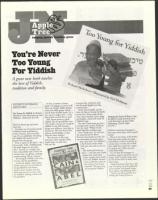
Too Young for Yiddish by Richard
Michelson, with illustrations by Neil
Waldman. (Talewinds; $15.95.)
Wow! It doesn't get any better
than this.
Certainly one of the best Jewish
children's books published in
recent memory, and one of the
top 25 ever published, Too Young
for Yiddish will catch you off
guard from the get-go.
First, it opens at the back — the
front reads, "Like a Yiddish book,
this book begins on the other
side." Second, it's a tender story
that is beautifully told. There's no
sarcasm here, no silliness, nothing
condescending. What a treasure.
Too Young for Yiddish is the story
of a boy and his grandfather.
As the tale begins, Aaron helps
Zayde carry up a ton of books to
his grandfather's new home:
Aaron's room. Zayde's wife has
died, and now he is to live with
his children, sharing a room with
his grandson.
At first, it seems to Aaron,
Zayde is bringing too much stuff.
There are Zayde's tefillin (phylac-
teries) and tallit (prayer shawl) —
and all those Yiddish books. It's a
tiny room to begin with — why
does Zayde need all this in here?
Still, Aaron yearns to speak
Yiddish. But his grandfather says,
"Oy, tateleh, you are too young for
Yiddish. In the Old Country,
things were different. Jews kept to
themselves. We were forced into
ghettos and forbidden to play
with the other children.
"But America is like soup.
Everyone mixes together. Here,
Jewish boys can play base-
ball just like
•
everyone else. And here, Jews
should speak English just like
everyone else."
Aaron loves baseball, and he
loves the big new home his family
moves into. Aaron reads all the
time, about baseball, about kings
and knights. Zayde still reads his
Yiddish books.
But then Zayde must go into a
nursing home, and his books go
into the trash: "Whole words
piled high like worthless rags."
Now, Zayde says: "In America,
the soup has lost its flavor.
Everyone has mixed too well. No
one remembers anymore where
they came from. For Yiddish it
is the bottom of the ninth,
with two outs and no one on
base."
But Aaron still wants to
learn — and this time Zayde
teaches him. And when
Zayde is gone, Aaron teach-
es his son Yiddish. Samuel
is just a little boy when he
asks to learn, but Aaron
responds: "You are never
too young for Yiddish."
Finding the Fruits of Peace: Cain
& Abel by Sandy Eisenberg Sasso,
with illustrations by Joani Keller
Rothenberg. (Jewish Lights;
$1695.)
Political correctness has gotten a _
bad name these days, and for good
reason.
Many, if not most, of the books,
films and other media are sappy
and shallow in their treatment of
certain issues. It's the sort of fluff
that might have made for a popu-
lar song in the 1960s, but posi-
tively reeks today.
It's not that the messages of
kindness, respect and peace are no
longer valid; it simply seems that
no one knows how to really write
about them. •
Sandy Eisenberg Sasso has a his-
tory of coming up with politically
correct books, and Jewish Lights
has a history of publishing them.
They're not all successful, but
Finding the Fruits of Peace is.
tIN •
5/24
2002
57