

Alarming Bias
Anti-Semitic violence across Europe carries harsh echoes.
,
.
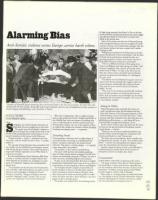
Members ofMarseille' ewish community bury the burned Torah in the Trois Lucs cemetery. On April 28, a fire
destroyed the Or Aviv temple, shortly after police had completed a patrol as part of heightened security measures at
Jewish religious sites following a series of attacks in France.
RUTH E. GRUBER
Jewish Telegraphic Agency
Rome
S
of right-wing extremist Jean-Marie Le Pen in the first
round of French presidential elections last week, trigger-
ing calls from Israel for French Jews to make mass
aliyah to the Jewish state.
Most of the attacks were the acts of alienated young
Arab immigrants hitting at Jews as surrogates for Israel
and were not part of an orchestrated campaign. But the
anti-Semitic violence has been coupled with a subtle
ideological shift.
Widespread sympathy for the Palestinians and wide-
spread identification of Jews and Judaism with the State
of Israel and its policies have opened the door to a
growing acceptance of classic anti-Semitic rhetoric in
both public discourse and private conversation.
"There is a difference between what's going on in
France and Belgium and what's going on in Italy," said
Francesco Spagnolo Acht, director of a Jewish music
study center in Milan. "In Italy, so far, there has not
been any violence. Here, anti-Israel and anti-Semitic
opinions are spread by local Italians. It is ideological,
but very vocal.
"The debate over Israel/Palestine has given room to a
series of anti-Semitic episodes that suggest a clear con-
nection between traditionally left-wing anti-Zionist
ideas with the more rooted Catholic anti-Semitic
beliefs," he said.
"Thus, even in the national and politically moderate
press, the old accusation of murdering Jesus has sur-
faced. Such accusations and mythologies are also being
adopted by the extreme-left newspapers. The mixture is
a true Molotov cocktail."
ynagogues are torched. Jewish cemeteries are
desecrated. Jews are roughed up on the street.
The recent wave of anti-Semitic violence in
parts of Europe has sounded alarm bells in the
Jewish world, prompting some commentators to corn-
pare the situation to the run-up to the Holocaust.
"Friends in Israel — Israel! — phoned to ask if we
were safe," said one mother of two in Paris. "I couldn't
believe it."
The upsurge of anti-Semitism has coincided with
the conflict in the Middle East and sharply intensi-
fied during the past month, when Israel launched a
large-scale military operation in the West Bank to
round up terrorists.
But the manifestations of anti-Semitism differ from
country to country, and there is ample evidence that
other elements are involved, too, including a re-emer-
gence of "traditional" religious and racial prejudices •
against Jews.
•
"The prejudices are the old ones, but the phenome-
non is broader," said Andras Kovacs, an expert on anti-
Semitism and nationalism at Budapest's Central
European University. "Being anti-Israel has become
somehow 'legitimate' today," he said. This, in turn,
"gives a new 'legitimacy' to the old anti-Semitism."
Why this is happening, what it might portend,
and to what extent the trend is linked specifically to
the Middle East crisis are matters of pressing con-
cern to individual Jews, Jewish communities and
Jewish policy-makers. So, too, is the question of how
to confront the volatile new situation without plunging
fruitlessly into despair, panic — or paranoia.
Disturbing Trends
'Anti-Semitism, it has been said, is a light sleeper. It
would be foolish, and wrong, to underestimate the
threat," warned an editorial in the London Jewish
Chronicle. "But there is a further danger — to magnify,
rather than tackle, the problem."
The problem, in fact, exists on several fronts.
The most visible has been the headline-grabbing
spate of violent attacks against synagogues, Jewish insti-
tutions and individuals, primarily in France, but also in
other countries, including Belgium and Germany.
To date, no one has been killed. But the Los Angeles-
based Simon Wiesenthal Center went so far as to issue a
travel advisory for Jews heading to France and Belgium.
The European Jewish Congress counted 360 anti-
Jewish incidents in France in the first three weeks of
April. According to France's Interior Ministry, more
than 60 percent involved anti-Jewish graffiti or verbal
abuse. But there were also a dozen attempts to set syna-
gogues on fire or damage graves.
The attacks were topped off by the shocking success
Mixing In Politics
"Many Europeans today, especially the citizens of
small, unimportant states, feel bewildered and lost,"
Tony Judt, director of the Remarque Institute at New
York University, wrote in the New York Times. "Their
countries and their institutions have lost their place in a
globalizing world economy — and, above all, in an
institutionally homogenized European Union."
In this context, Kovacs said, it has been easy for some
to focus on the age-old symbol of borderless, interna-
tional identity — the Jew.
"There are a lot of concrete political problems now,
and all of them can be brought into connection with
the Jews and Israel in a way," Kovacs said.
"For those who are anti-Semitic, this is a perfect way
to legitimize this attitude," he said. "One symbol unites
them — the Jew, the cosmopolitan Jew against nation
state, the cosmopolitan Jew bound to America."
Another important factor, he said, is the difficulty in
understanding the loyalty felt by Jewish citizens of
European countries to another state, Israel.
Counterattack
Jewish leaders, meanwhile, are gearing up for action.
"On many occasions when there is a deterioration in
the social fabric, it starts with the Jews, especially here
on this continent where there has been a history of anti-
Semitism," Avi Beker, secretary-general of the World
Jewish Congress, said last week in Brussels.
Beker spoke at a strategy session of world Jewish lead-
ers, who agreed to set up a Jewish information center to
monitor anti-Semitism in Europe and serve as a politi-
cal voice and lobby for European Jewry.
❑
5/3
2002