

Little Support
Israel finds that world backing is a fleeting thing.
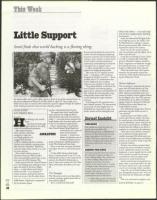
An Israeli soldier and a police o wer patrol in front of one of the attacked houses in
the Jewish settlement of Adora in the West Bank on April 27. Four people were
killed and at least six injured when Palestinian gunmen slipped through the defenses
of the settlement and went house to house shooting residents.
LESLIE SUSSER
Jewish Telegraphic Agency
Jerusalem
1.I
ow fleeting is the world's
fancy.
Less than two years ago,
Israel seemed to be riding
a wave of international popularity.
After years of interna-
tional criticism, Israel had
managed to regain the
moral high ground in its
struggle with the Arab
world by withdrawing from southern
Lebanon and making a sweeping peace
offer that had "unmasked" Palestinian
Authority leader Yasser Arafat as an insin-
cere peace partner.
Now, Israel's military success in
Operation Protective Wall has left it
more internationally isolated than at any
time since the 1982 Lebanon War.
Israel's quarrel with the United Nations
over a fact-finding team seeking to inves-
tigate the battle in the Jenin refugee
camp — a team whose arrival was in
doubt this week — is a measure of
mutual mistrust. And the fact that the
team was set up in the first place shows
just how isolated Israel has become.
The speed with which Israel's diplo-
matic position has collapsed offers a
sobering lesson about the international
reality — and raises serious questions for
Israeli leaders who formulate policy with
an eye to international repercussions.
Just 21 months ago, it seemed that
then-Prime Minister Ehud Barak had
removed the twin causes of
years of international
reproach — Israel's occu-
pation of a security zone in
southern Lebanon and its
denial of Palestinian self-determination
in the West Bank and Gaza Strip.
How, in less than two years, has Israel
once again become an international pari-
ah?
In May 2000, Barak pulled Israeli
forces in Lebanon back to the U.N.-cer-
tified border. In July, at the Camp David
summit, he offered the Palestinians a
state in Gaza and virtually all of the West
Bank, with eastern Jerusalem as its capi-
tal.
ANA LYSIS
Leslie Susser is diplomatic correspondent
513
2002
18
for the Jerusalem Report.
The Strategies
The Palestinians said no and launched a
terrorist campaign against Israel with no
clear political agenda.
Yet, it is Israel that finds itself
denounced and isolated in much of the
world, with the Europeans considering
economic sanctions, the United Nations
voting to send a mission to probe Israel's
moral conduct and the international
community contemplating the dispatch
of armed forces to impose a peace.
In effect, Israel's effort to court world
opinion has backfired dramatically.
After years of U.N. hostility toward
Israel — including a 1975 resolution
denigrating Zionism as racism — Barak
carefully won U.N. confirmation that
Israel's withdrawal from southern
Lebanon was complete to the last inch.
That, Barak believed, would form the
basis of Israel's new deterrent policy
against Syria, Lebanon and Hezbollah: If
they violated the internationally recog-
nized border, Israel would have the
world's backing for tough retaliatory
measures.
Israel's hopes for fair treatment have
been dashed, however: The international
community has been largely silent as
Hezbollah has continued to stage cross-
border attacks and has kidnapped and
atel 11110414
THE ISSUE
The media are reporting that the
Israeli army standoff with
Palestinian gunmen at Bethlehem's
Church of the Nativity has roused
anger throughout the Christian
world. That same media has mostly
failed to recognize the real insult to
Christian sensitivities occurring
there.
,
BEHIND THE ISSUE
Christian churches have been known
for centuries as places of safety for
those seeking refuge. But traditional-
. ly, those seeking.refuge leave their
weapons at the door and show
respect to the church and its caretak-
ers while inside. Palestinian gunmen
. at the Church of the Nativity
brought their guns in with them,
took civilian hostages and have
caused destruction to the shrine.
— Allan Gale, Jewish Community
Council of Metropolitan Detroit
killed Israeli soldiers — yet Israeli retalia-
tion has been condemned for escalating
the situation.
Barak also believed he had gained the
moral high ground in the conflict with
the Palestinians by making an unprece-
dented, generous peace offer, which was
rejected and repaid with violence.
Barak was sure the world would see
who wanted peace and who didn't, but it
didn't work that way.
Ironically, by resorting to terror, Arafat
was able to recapture the moral high
ground. Palestinian violence seemed to
imply a legitimate and desperate struggle
for national liberation, no matter what
Israel had offered and Arafat rejected.
When the Israeli army took counter-
measures, the perception around the
world was of the Israeli Goliath persecut-
ing the Palestinian David.
Sharon In uence
The sea change in international opinion
came with the Israeli election of Ariel
Sharon as prime minister in February
2001. Almost immediately, there were
moves to initiate a lawsuit against Sharon
for his alleged role in the 1982 massacre
of Palestinians in the Sabra and Shatila
refugee.camps in Lebanon by Maronite
Christian forces, when Sharon was
Israel's defense minister.
The subliminal message from Sharon's
adversaries was that Israel was now a
"war criminal."
Israel's position was further under-
mined when Sharon made it clear that
he would not go as far as Barak to pla-
cate the Palestinians. Israel could now be
portrayed as power-driven, unwilling to
compromise and willing to use force to
maintain its occupation and settlements.
There also was an inherent contradic-
tion in Sharon's strategy against the
intifada (uprising): His initial tactic was
to exert as much diplomatic and military
pressure as he could on Arafat to get him
to stop the violence.
But the more military pressure Israel
exerted, the more international criticism
it drew Diplomatic pressure on Arafat
dissipated, as many argued that he could-
n't be expected to meet his anti-terror
.commitments when his regime itself
seemed to be under Israeli attack.
Israel received some international sym-
pathy when it restrained itself in the face
of terrorist attacks, but at the untenable
cost of ever-increasing civilian casualties.
Amos Oz, one of Israel's leading novel-
ists, distinguishes between the "two wars"
that Israel and the Palestinians are fight-
ing.
One is to end Israeli occupation, and
LITTLE SUPPORT on page 22