

tr
Holidays
A Pink And
Purple Haggadah
Family recalls its painful Holocaust history,
but celebrates Jewish survival with joy.
ELIZABETH APPLEBAUM
AppleTree Editor
I
t isn't only memories from thousands of years
ago — of slavery, suffering, fear — that come
alive at the Pesach table of the Hartman-Silow
family. They remember, too, the anguish of
only a few decades ago.
"At our seder, we always talk about the Holocaust,"
says Sarah Hartman-Silow, who, with her husband,
Dr. Charles Silow, lives in Huntington Woods. "We
talk about what it was really like to be slaves, about
what the Jews have gone through."
The seder includes readings from Anne Frank and
Primo Levi and other Holocaust survivors, "and that
makes it very, very personal," Hartman-Silow says. "It's
a humbling experience, because you really can begin to
feel that you yourself have been delivered, as the
Haggadah tells us we are supposed to."
But first, there's the cleaning. And just in case the
Silows, members of Congregation Or Chadash, have
forgotten about that, they have daughter Shoshana, 5.
"Shoshie just said to me, 'Isn't it time for you to
start cleaning?'" her mother says, laughing.
So, she is cleaning. And, while she is cleaning, she is
preparing. Family is coming for one seder, and friends
— and anyone else who has nowhere to go — come
to the second. "We always try to include those who
might need a place," she says.
There is something for everyone at the Silow seder
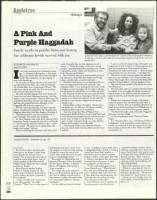
Sarah Hartman-Silow, with husband Dr. Charles Silow and daughter Shoshana,
5, displays a ceramic seder plate she created depicting faces designed for each item
on the plate.
table. Normally, they eat only vegetarian meals at
home — "which also makes it a lot easier to keep
kosher," notes Hartman-Silow, standing in her charm-
ing kitchen, which is filled with Shoshana's art proj-
ects. "Just one set of dishes."
But on Pesach, they try to accommodate everyone.
So they serve a main dish that usually involves egg-
plant, and they order a catered meat meal.
"Actually, I don't know how we developed this cus-
tom of eating meat for the week of Pesach," says
Hartman-Silow. "I was working full time and I could-
n't figure out how to prepare all the meals in advance
so we ordered in, and all that was available was meat."
Her husband will dine on the meat while her sister,
Andrea, who also lives in Huntington Woods, is a veg-
etarian, as are nieces and nephews. So the meal will
include an array of pareve kugels and even pareve
chicken soup.
Charles Silow conducts the seders, "and he does a
wonderful job," his wife says. "He always includes
everybody and he asks a lot of questions.
"Last year, he got this 'Box of Plagues' from
Borenstein's [Books -8c Music Store in Oak Park], and
it had all these toy animals and red stuff that you put
in the water to make it look like blood. It was just
great. It really invigorates things, too, when Shoshie
throws all the plagues around the table."
The Hartman-Silows' seder table also features
charoset, which Sarah Hartman-Silow says she "loves
making."
"I start out with the typical recipe, with apples and
walnuts, but I tend to throw in other things, too, fruit
and nuts and whatever I find around the house.
Sometimes, I'll make several kinds" — all in the shape
of a pyramid. (It's easy, she insists — just shape it!)
The means always served on plates, fine and deli-
cate, that once belonged to Dr. Silow's mother, Sara
Silow. "She bought them a few years after being liber-
ated from Bergen-Belsen," says her daughter-in-law.
"She was the only member of her family to survive
the Holocaust."
The seder plate itself was created by Hartman-Silow,
a sculptor. It was a struggle, she admits, because she
was so certain in her mind of what she wanted the
plate to look like, and then she had to work to make it
that.
Perhaps most important, though, is Shoshana's
many art projects that will adorn the seder table. A
student at Yeshivat Akiva in Southfield, Shoshana reg-
ularly brings home everything from Kiddush cups to
matzah covers, each of which her parents treasure.
"I've heard she made a pink-and-purple Haggadah
this year," says her mother.
At last, everything is ready. Pesach will soon
begin.
It is, Hartman-Silow says, a life-giving holiday, a
celebration, "such a dramatic moment because it
mark's our existence as Jews for thousands of years.
It's amazing to think about that. What incredible
continuity." ❑
FINDING FATHER'S AFIKOMEN on page 110
ever since.
For the first seder, the Deitsches
often go to the home of their long-
time friends Dr. Ed and Verne
Royal. The second seder they like to
spend at home with Jaime, now 16
and a student at West Bloomfield
High School, where she has a special
interest in theater.
Janet Deitsch teaches Sunday
school at Temple Emanu-El. Her
seder meal will feature both salmon
and a turkey, the latter prepared by
her husband.
"I take a turkey and I coat it all
over with paprika," says Bob
Deitsch. "Then I set it in the oven at
3/22
2002
110
400 degrees and turn it once every
20 minutes to make sure the coating
of paprika covers the entire bird.
That's what holds the juices in and
keeps it wonderfully moist."
This might be followed by the
Queen's Chocolate Cake, so named
for the Queen Mother, or Queen
Mum, of England, who is said to
have invented it.
The recipe uses nuts instead of
flour, and Bob Deitsch came up with
the idea of adding matzah meal at
the bottom in place of breadcrumbs.
("A very minor addition," he says
modestly.)
On the table are favorite holiday
items, including a Lenox seder plate,
a Haggadah from a friend in Israel, a
tablecloth from Bob's mother, a
Kiddush cup from Janet's mother,
Eleanor Parker, and a glass dish with
a Hebrew inscription that the couple
received from the cantor at their
congregation in Manhattan.
"I was a real-estate agent there,"
Janet Deitsch says. "When he and
his wife were looking for a place to
live, I showed them a lot of co-ops.
They didn't buy anything from me
(though they wound up renting),
but they gave us this gift."
The Deitsches have a tradition of
inviting guests, including Janet's
"adopted Michigan mother," Berti
Liffman, and people they don't even
know. Each Pesach, they put in a call
to Temple Kol Ami's Rabbi Norman
Roman and ask, "Who is new in
town? Who doesn't have anyone to
celebrate with?" and suddenly, the
table will be filled.
Best of all, everyone gets a treat.
When it comes time to find the
afikomen, it isn't just the little ones
who get a finder's fee: "We do any-
one under 21," Janet Deitsch says.
(Sorry, we can't divulge what the
treat will be; it would spoil the sur-
prise.) ❑