
days, and on Pesach fami-
ly from throughout New
York met for the seders.
It made "very happy
memories for us," she
says.
Because she knew the
most Hebrew, Janet usu-
ally asked the Four
Questions.
Her father hid the
afikomen, and everyone
got a reward when the
hidden piece of matzah was found. "There
would be half-a-dozen kids waiting for the
prize," often a new dollar bill, or maybe some-
thing extra-special, in more recent years, like a
Susan B. Anthony coin.
Her father was "a happy man," she says. The
owner of Parker Steel Products, which manu-
factured steel cabinets, he was a very good
provider with a good sense of humor who
had three older sisters who always doted on
him."
"It was Dad who first sent me and some of
my sisters with a bottle of kosher wine to give
a few of the neighbors, to help them celebrate
the holiday," she remembers. "Even today, I
usually buy flowers or a little gift for our
neighbors, too."
After they married, Bob and Janet Deitsch
stayed in New York until Janet became preg-
nant with David's sister, Jaime. By then, the
couple was living in Manhattan and the idea
of moving to an apartment with one more room
("it would mean about another $100,000," Janet
Deitsch says) was anything but appealing. So the
fimily settled in Michigan, where they have lived
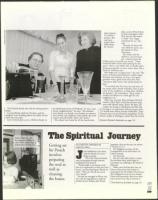
Jaime Deitsch,
16, and her
patrents, Bob
and Janet,
prepare their
table setting
for Passover.
The Deitsch family also will be missing Janet's
father.
•
Leonard Parker died last October, and his
daughter loves thinking about the seders he led
when she was a girl.
Janet Deitsch grew up in a Reform family in
the Midwood section of Flatbush. "It was a very
Jewish neighborhood," she says. "My teachers
were Jewish, my friends were Jewish, my doctors
were Jewish, my neighbors were Jewish, the store
owners were all Jewish. That's all I knew."
Her school was closed for all the Jewish holi-
FINDING FATHER'S AFIKOMEN on page 110
The Spiritual Journey
Judy Goldsmith and
her daughter, Molly 8
cover their countertops in
preparation for Passover,
,
Getting set
for Pesach
involves
preparing
the soul as
well as
cleaning
the house.
O
V)
ELIZABETH APPLEBAUM
AppleTree Editor
IT
udy Goldsmith is just about
ready for Pesach, but some-
thing is missing.
.
She is the master of cleanli-
ness, having gone through cabinets,-
bookshelves and drawers.
"People laugh at me because I take
this as an opportunity to clean the entire
house," says the Huntington Woods res-
ident. "They ask, 'But do you eat in
your closets?'"
She also has managed to fill her cabi-
nets with the ingredients to make her
family's favorite holiday dish: Pesach
,
pancakes. (Just try the mix, she advises.
"We live on it.")
The Haggadot are there, all the
arrangements set for both seders. So
what's missing?
The bitterness.
On each seder plate, there is a place
for the bitter herb, which helps us
remember our suffering at the hands of
Pharaoh.
Today, many feel that they, too, are
slaves as they scour their homes in
preparation for the holiday. Not only are
Jews obligated to toss out any chametz
(food with leavening), they are to clean
their homes from top to bottom to
THE SPIRITUAL JOURNEY on page 111
\"
ts*. •
3/22
2002
109
Scanned image of the page. Keyboard directions: use + to zoom in, - to zoom out, arrow keys to pan inside the viewer.
March 22, 2002 - Image 109
- Resource type:
- Text
- Publication:
- The Detroit Jewish News, 2002-03-22
Disclaimer: Computer generated plain text may have errors. Read more about this.