

F rom The Past
O
ca
nonprofit organization, I offered him a $1,500 tax
write-off" But Franklin wanted cash, and he asked
Sapoznik what he had on him.
Legend has it that Sapoznik paid $30 for the lot
of it.
"Actually, it was more like $28 and some change,"
he says, "and Franklin doesn't know this, but I held
back five bucks for cab fare."
Championing Yiddish Culture
Sapoznik quickly located a compatible turntable.
He put the first disc on and placed the needle into
the groove. There were pops and crackles and an
announcer's voice:
"From atop the Loew's State Theater Building,
the B. Manischewitz Company, the world's largest
matzah bakers, happily present Yiddish Melodies in
Swing!"
A band strikes up with rolling drums and swelling
horns as the announcer presents Sam Medoff and
the Yiddish Swing Orchestra. With a "Hit it, maes-
tro!" the musicians launch into a jumping rendition
of "Dayenu."
For Sapoznik, this was the first glint of a buried
treasure, an all-but-forgotten period of Jewish-
American history that he has dedicated the last 16
years to unearthing.
An ethnomusicologist and Grammy-nominated
musician and producer, Sapoznik has long champi-
oned the cause of Yiddish culture. He is the founder
of KlezKamp, a Yiddish folk arts program, and is
_ widely acknowledged as the leader of the klezmer
revival, which he documented in his 1999 book,.
Klezmerk Jewish Music from Old World to Our World.
With the discovery of these recordings, Sapoznik
now realized that the history of Yiddish culture in
VOICES on page 76
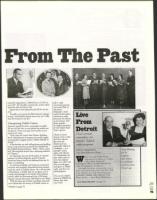
Left to right:
A promotional poster,
circa mid-1930s, of
"the Jewish
Philosopher," Israel
Lutsky the first advice
columnist on radio,
famous for his abrasive
on-air presence. Carl
Reiner provides
the English translation
for this Yiddish Radio
Project segment.
Charles A Levine
became a hero to New
York Jews when he
flew across the
Atlantic just two
weeks after Charles A.
Lindbergh — as a
passenger. Levine,
right, with Clarence
D. Chamberlain, his
pilot, before their his-
toric trans-Atlantic
flight, circa 1927 His
story was told again
and again on Yiddish
radio, and then com-
pletely forgotten.
The cast of a Yiddish
drama on WBATZ, the
Bronx, New York,
circa 1933.
Hills rec
a
calls reminding her to
on pro-
Although the series col
grams and performers from the New York
area, Detroit, too, had an exciting and
profitable Yiddish radio industry. And
Bette Schein --- born Bette Weinberc 0 , —
ten
Schein,
p ublicity
t from about
60 years ago.
LIVE FROM DETRorr on page 76
3/15
2002
75