

()Ices
A 10-week series
celebrating the
golden age of
Yiddish radio
illuminates Jewish
immigrant culture
in America.
JOEL TOPCIK
Serendipity
Special to the Jewish News
The Yiddish Radio Project began one afternoon in 1985 when Sapoznik, then the
sound archivist at the YIVO Institute for Jewish Research, in New York City,
received a call from a friend about an office sale.
Joe Franklin, a local broadcasting legend, was moving out of his Times Square
office,' leaving decades worth of broadcasting memorabilia for the taking. Sapoznik
was on his way.
"When I got there, it looked like the nostalgic equivalent of the beach at
Dunkirk," he recalls, with a characteristic metaphorical flourish.
As the founder of YIVO's collection of early 20th-century Yiddish recordings,
Sapoznik routinely scoured flea markets and estate sales in search of the detritus of
history. Now, picking through Franklin's collection of old publicity photos and film
reels, he nearly stumbled over a stack of rare phonographic discs.
They were radio transcription discs, pressings of broadcasts made for archival pur-
poses before the days of analog tape. Sapoznik grew more intrigued as he read the
titles on the worn labels: Yiddish Melodies in Swing, Life zS Funny with Harry
rom the 1920s to the 1950s, Yiddish radio was the voice of
the Eastern-European Jewish immigrant, a lifeline back to
the Old World and a mirror held up to the daily hardships
of life in the new one.
For decades, the remnants of this vital period in Yiddish-American
history lingered in obscurity and in the fading memories of generations.
Until Henry Sapoznik nearly tripped over them.
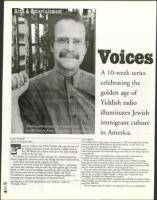
Sapoznik is the man behind the Yiddish Radio Project, a documen-
tary series that celebrates what he calls "the other golden age" of radio.
Based on 500 hours of recordings rescued from attics and dumpsters,
the 10-part series will air on National Public Radio's All Things
Considered on consecutive Tuesday afternoons beginning March 19,
restoring a lost chapter to the history of American Jewry.
Joel Topcik is a Neu.) York-based freelance writer and former resident of
Huntington Woods.
3/15
2002
74
Hirschfield; The Molly Picon Maxwell House Program.
/ In all his years of collecting Yiddish recordings, Sapoznik had never heard of these.
When Franklin himself walked over to check on his progress, Sapoznik had set aside
more than 200 discs.
"He was happy to get rid of them," says Sapoznik. "Since I was working for a