
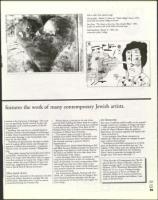

Left to right, from opposite page:
Frank Stella: "Warka II," from the "Polish Village" Series, 1974,
wood, felt and canvas collage on board.
Jim Dine: "The Heart at Sea (in a Non-Secular Way)," 1981,
acrylic on canvas with conch shells and wood strip.
Saul Steinberg: "Speech 2," 1969, ink,
watercolor, pastel, collage.
features the work of many contemporary Jewish artists.
emerita at the University of Michigan. "His work
was not specifically Jewish. Instead, he drew the
iconography, such as identity papers, of the dis-
placed person."
Steinberg, who was born to a Jewish family in
Romania, earned a doctoral degree in architecture
in Italy, where he published his first cartoons. The
artist's early drawings in the United States were
done for the New Yorker.
"Steinberg was fascinated by the ways in which
each of us gains official reality only through our
presence in official documentation — passports,
identity cards, tax reports, licenses," Kirkpatrick
says.
"Fake rubber stamps had served the artist well in
successfully 'reactivating' an expired passport to
help in his escape from Mussolini's Italy, an experi-
ence that continued to inspire him. Bogus rubber
stamps validate key areas of Speech 2's space and
personage, suggesting that the entire work repre-
sents a special kind of identity document."
More Jewish Artists
Joseph Hirsch, immersed in the expression of urban
and social realism, focused on everyday life. His
exhibit piece, Deposition, done in oils on canvas,
was painted during the Vietnam War.
"Hirsch depicts a comrade in the role of the
grieving Mary, holding the lifeless body of a soldier
who seems paradigmatic of all young men sacrificed
on the altar of war," explains Dora Apel, the W.
Hawkins Ferry chair in modern and contemporary
art history at Wayne State University
"The central image is rooted in the Social
Realism of art before World War II but also is con-
nected to the existential doubt and implicit search
for universal meaning in postwar Abstract
Expressionism."
Philip Pearlstein's Female Model Reclining on Red
and Black American Bedspread typifies his depictions
of graceless nude figures in stark settings. Because
the head is not shown, the artist takes away from
the individuality of his subject.
Louise Nevelson's Black Zag I, completed in 1968
using wood and Formica as part of a sculptural
series of wall reliefs, has many compartments filled
with small forms that were either made or pur-
chased. The black pieces inside a black holding area
raise questions about the connection between parts
to the structural whole.
Roy Lichtenstein's Modular Painting with Four
Panels, No. 7 exemplifies his Pop Art imagery that
uses industrial printing techniques. His dot pat-
terns, reminiscent of comic books, also suggest Art
Deco design.
Art Partnership
The entire Cranbrook exhibit readily can be accessed
through a hard-cover catalogue of images and essays
—Three Decades of Contemporary Art: The Dr. John
& Rose M. Shuey Collection. After the exhibit is
taken down, the museum regularly will display indi-
vidual works from it.
In the catalogue, Rose Shuey comments on
whether the collection always was enlarged by agree-
ment with her late husband.
"Sometimes we had little contentions as to which
piece we should buy, and we didn't buy any," she
explains. "Other times, and I am talking about the
two works by Frank Stella from the "Imaginary
Places" series in particular, he bought his, and I
bought mine. Now that's collecting!" 0
"Three Decades of Contemporary Art: The Dr.
John & Rose M. Shuey Collection" will be on
display through April 7 at the Cranbrook Art
Museum, 39221 Woodward, Bloomfield Hills.
Hours are 11 a.m.-5 p.m. Tuesdays-Sundays
with an extension to 9 p.m. on Fridays. $5
adults/$3 children 6-17, seniors and full-time
students; free for members and children 5 and
under. (248) 645-3323.
. ,tk!
2/22
2002
73