

Arts Entertainment
Superbly
Gif te d
The donation of the Shuey collection to Cranbrook Art Museum
SUZANNE CHESSLER
Special to the Jewish News
A
2/22
2002
72
n abstract work of art recalling a Polish
synagogue destroyed by the Nazis is part
of a broad-based collection recently
donated to the Cranbrook Museum of
Art and on exhibit through April 7.
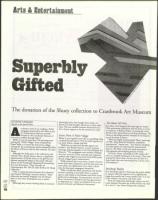
Warka II, one of more than 130 paintings corn-
prising the "Polish Village" series completed by
Frank Stella, is a wood, felt and canvas collage
among the 46 contemporary pieces amassed by Rose
M. Shuey of Detroit and her late husband, Dr. John
Shuey.
Although the Stella piece is the collection's only
artwork with a Jewish theme, there is a significant
representation of Jewish artists in the gift that has
become among the largest in the nearly 100-year
history of the Cranbrook Educational Community.
It is now showing as "Three Decades of
Contemporary Art: The Dr. John & Rose M. Shuey
Collection."
"This is a great donation because of its diversity,"
says Gregory Wittkopp, museum director. "Most
collections are heavily weighted, but the Shueys
seem to have been thinking the way a curator
thinks.
"Although they weren't looking ahead to museum
[showings] when they bought these works, it's
almost as if they brought objectivity to their selec-
tions. The one notable common denominator in
their choices appears to be the attention to color."
Scenes From A Polish Village
Warka II, put together more like an assemblage than
a traditional painting in 1974, has bold segments of
hot pink, lemon, orange and blue.
"Stella has set order and disorder against one
another," says Richard Axsom, curator of prints,
drawings and photography at the Grand Rapids Art
Museum. "The synagogues were wooden buildings
that were unusual in their materials and carpentry,
qualities that might be associated with Stella's paint-
ed and collaged wood 'constructions.'
"Stella asserted that it was more a matter of associ-
ations than direct inspiration and that the series was
more about 'the obliteration of an entire culture'
than the destroyed synagogues themselves.
"What complicates these associations and further
enriches meaning is that Stella chose to expand
upon a style linked to the Russian and Soviet avant-
garde and its ideologies. Constructivism was one of
the art movements reviled by the Nazi government
as 'degenerate art,' which was declared to be a con-
spiracy of Jewish and Bolshevik discontents."
The Heart Of Dine
Jim Dine, who designed the heart logo for Israel's
50th anniversary celebration and has been an artist-
in-residence at Kibbutz Kabri, is among the many
Jewish artists represented in the Shuey holdings. The
Heart at Sea brings another example of his frequent
use of the heart as theme.
"With the highly emotionalized 'Heart' paintings
of 1981, Dine declared himself an unabashed
expressionist," Axsom says. "In a bravura handling
of acrylic paints, he surrounds his monumental
heart in The Heart at Sea and nearly inundates it
with agitated and sweeping gestures of color.
'All of the 'Heart' paintings of 1981 made refer-
ences to troubled landscapes of the mind. They were
inspired by Dine's deep concern over the fate of a
close friend who was recovering from a severe men-
tal breakdown."
Steinberg's Reality
Saul Steinberg's Speech 2 showcases the artist's ability
to capture what first appears to be a lighthearted
image but actually has a more somber side. It is one
or the exhibit's rare pieces with little color.
"From the beginning, Steinberg's subject was the
wacky disparity between the world and the way each
of us sees it," says Diane Kirkpatrick, professor