

Remember
When •
Ideas & Issues
From the pages of the Jewish News for
this week 10, 20, 30, 40 and 50
years ago.
' Debate between moderates shows deep gap in Middle East perceptions.
HARRY KIRSBAUM
Staff Writer
I n their own communities, these Jewish and Arab
spokesmen are each considered moderates.
But when together, their differences show how
slim the chances may be for peace in the Middle
East.
David Gad-Harf, Jewish Community Council of
Metropolitan Detroit executive director, met with Nasser
Beydoun, director of the Dearborn-based Arab American
Chamber of Commerce, for a friendly debate at the
Community House in Birmingham on Jan. 10. On nearly
every issue, they disagreed strongly, but politely.
We want nothing more than for the people of Israel and
its neighbors to live in peace," said Gad-Harf, whose
remarks covered 50 years of the region's history. "Any kind
of war and bloodshed is horrible — and we want that to
come to an encl."
He also told the crowd of 150 that the Israeli govern-
ment actually supports the concept of a Palestinian state.
But Israel also has a right to defend its citizens, who fear
for its survival and are horrified by the incitements to vio-
lence voiced by some Arab and Muslim leaders and found
in Palestinian schoolbooks.
"I'm generally an optimistic person, but the develop-
ments in the last 15 months have really strained my sense
of optimism," he said. "We in the Jewish community are
looking for positive signals from the Palestinian leaders that
they are ready to move in a new direction."
Beydoun said people shouldn't think of the Middle East
in terms of the last 50 years. "Arabs and Jews have co-exist-
ed for thousands of years," he said. "The Palestinians need
a viable state, and the Israelis need a viable state."
Israel has a right to defend itself, but we don't believe in
assassinations without trials, Beydoun said.
And peace is not possible with Israel expanding settle-
ments in the West Bank and Gaza, he continued. Israel is
occupying Palestinian land. The Palestinians must have a
viable state, not a township or section separated by Israeli
military roads, checkpoints and settlements.
"The incitement to violence is also present in the Israeli
press and it also comes &Om Israeli officials," he said.
"Both sides are wrong. Israel will never have security until
the Palestinians have peace. You cannot eliminate suicide
bombers until you give people hope."
Gad-Harf and Beydoun met as part of a discussion on
Arab Americans and Islam, said Deena Lockman, who,
with Administrative Law Judge Raymond Sewell Jr., co-
chairs the Birmingham-Bloomfield Task Force on Race
Relations and Ethnic Diversity.
The organization has met once a month for about 17
years for people interested in broadening horizons.
After Sept. 11, they held the first program on Arab
,,, \ ,,
v \,,,v-- • '''\
Z-
0
CCOMCw
A new manual issued by the Union
of American Hebrew Congregations,
A Jewish View of Teenage Sexuality,
offers discussions of sensitive issues
facing teens.
Sinai Hospital of Detroit estab-
lished new visiting hours to optimize
patient care.
Amy Simon of Bloomfield Hills, a
sophomore at Brandeis University in
Waltham, Mass., was accepted to the
Mt. Sinai School of Medicine in
New York City.
1982
A 22-year-old Palestinian was killed in
a shooting in the Rome office of the
Palestine Liberation Organization.
Diane C. Weiner of Franklin was
appointed resident horticulturist at
Harrison Tree Services in Royal Oak.
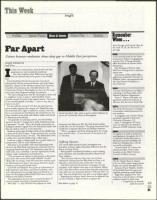
David Gad-Harf, right, makes a point as Nasser Beydoun lis-
tens at the Community House in Birmingham.
Americans and Islam, but felt that Arab-Israeli conflict
would take over the discussion. The group announced they
would have a separate talk about the Mideast situation.
"This is a program we'd been thinking about for a long
time, and this [Sept. 11] was the kick in the pants to do
it," she said.
Differing Opinions
The crowd asked questions - about sovereignty over
Jerusalem, military might, leadership differences and the
failure of Camp David.
Both speakers considered Jerusalem a major sticking
point. Beydoun said Jerusalem should be shared by all
three religions.
"Jews can pray whenever they want, but if you're
Palestinian coming from the West Bank or Gaza, it all
depends on the security issue of that day," he said.
Gad-Harf said Israel shoud have sovereignty over all
Jerusalem, with religious sites open to all religions. Before
1967, "Jews did not have access to their holy sites, and, in fact,
those holy sites were desecrated between 1948 and 1967," he
said. "Jews and Israelis don't want that to ever happen again."
Regarding the military, Israel's forces are far superior, but
are not intended to fight terrorism or against the
FAR APART
on page 22
The Uval Life Insurance Company
in Jerusalem reduced premiums for
non-smokers.
A synagogue and a kosher dining
cooperative opened at Princeton
University, Princeton, N.J.
Jason L. Honigman of Center
Line was elected to the board of
directors of MSP Industries Corp.
t.
.
. , . .
An appeal was made to governors
and legislators throughout the U.S.
to liberalize Sunday blue laws to
eliminate economic hardship suf-
fered by Orthodox Jews, who do
not work on Saturday. .
Detroiter Rose M. Cowan was
elected president of the Ladies
Auxiliary to the Allied Veterans
Council of Wayne County.
e4VVEr*AirNiel
The St. Charles Hotel in Atlantic
City, one of the nation's largest Jewish
hotels, was severely damaged by fire.
Detroiter Harry Sheplow, resident
of the Jewish Home for Aged, was
regularly producing candle holders.
Bagel blues plagued New York
City Jews as the slowdown of bagel
workers entered its third week.
—Compiled by Sy Manello,
editorial assistant
1/18
2002
21