

from. People on the East Coast are more familiar with
Canada. But the farther south you go in the U.S., there
might be less connection.
"It's such a massive country," she added, "that to
know most of the Canadian population is 75 miles
from the U.S./Canada border isn't something you'd
expect. Besides, the subtleties are the most interesting
things about culture in general."
Splendid Isolation
On the back of a cartoon coaster / In the blue TV
screen light / I drew a map of Canada / Oh, Canada /
Vasstanastarsamsztammon
With your face sketched on it twice / Oh, you're in my
blood like holy wine
fr om (.`,4 Case of You,"
by Joni Mitchell (1971)
Canada's relative isolation is an advantage for such
artists as Wainwright, who cherish being able to devel-
op at their own pace.
"I think Canada is probably one of the greatest, and
most wonderful, places to write [songs]," he said from
a concert stop at the Universal Amphitheater in Los
Angeles. "It has been for me, anyway, in terms of being
able to clear out your head and get a fresh perspective.
There's not much to do up there!
"Bur in terms of establishing your career and selling
records, you have to go to New York or Los Angeles or
Paris, especially if you're a performer. If you're just
doing DJ mixes, it doesn't matter."
What does matter is the quality of the music, be it
by such established artists as the Cowboy Junkies and
Blue Rodeo or such lesser-known talents as the rocka-
billy-championing Royal Crowns and young country-
music singer Amanda Stott.
Yet, while many Canadians long ago proved them-
selves the qualitative equal of their counterparts here
and in Europe, living so close to the United States has
been both a blessing and a curse.
This holds especially true for those musicians who
want to make an impact beyond their country's bor-
ders, without sacrificing their cultural identity or their
Canadian listeners.
"I think it's the same for everybody," Wainwright
said. "You have to go to these major markets, whether
you're from Africa or Canada, to make it [big]. I'm not
saying you have to live there, but there are cities that
are market centers and cities that are pleasant to live in.
The major markets are where you get critical response
— either acclaim or they destroy you — in the world."
Those sentiments were seconded by Krall, whose lat-
est jazz album, The Look of Love, entered the U.S. pop
charts at No. 9.
"You can talk to an artist in any medium — an
actor, a painter, a musician — and they want a chal-
lenge," she said from Beverly Hills, where she has a
home. "Ja77 is an American art form, and I moved here
because this is where the action is."
Staying true to their roots has long been a challenge
for Canadian artists working in the shadow of the
internationally dominant U.S. music industry, so much
so that the Canadian government mandates that 35
percent of all music heard on the country's radio out-
lets be by Canadian artists.
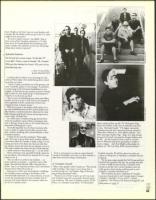
Above, clockwise from top left: The Philosopher Kings
eature the brothers Levine, Jon on keyboards and Jason
on bass. Barenaked Ladies: "The biggest expectation
Canadians have for their musicians who go abroad] is:
`Please don't embarrass us. Don't offend anybody''' said
BNL lead singer Stephen Page. Singer k.d. Lang recently
discovered her Jewish roots and has brought Judaism into
her life. Jew-Bu Leonard Cohen, raised in a Jewish
home in Montreal, found the spirituality he sought in
Eastern religion. Left: Paul Shaffer acknowledges his
Judaism on "The Late Show With David Letterman."
Even so, the pressure to make an impact beyond
Canada is formidable, and many acts don't hesitate to
tailor their music for foreign consumption.
A Canadian Sound?
"Often, when people within Canada say: 'That sounds
really Canadian,' they mean it as an insult, that it
sounds second-rate," said Stephen Page of Toronto's
pop-rocking Barenaked Ladies.
"Because a lot of what we grew up with was music
that imitated music that was popular. Record compa-
nies would say: 'We need a Canadian [version of] the
Police, or a Canadian Limp Bizkit.' We (Barenaked
Ladies) are lucky. We still live there, but we're not
reliant on filling bars in Hamilton or [nearby] Toronto
anymore.
"It's the same reason people like Neil Young and Joni
Mitchell left Canada in the '60s. By moving, they did-
n't have to fulfill an idea of what a 'Canadian artist'
should sound like. But I think Canadian artists are
really good at observing the world around us, and
bringing a Canadian sensibility to it."
That sensibility has been a hallmark of Canadian
musicians dating back to such vintage songs as Young's
"Helpless," Mitchell's "A Case of You," Gordon
Lightfoot's "The Wreck of the Edmund Fitzgerald" and
NORTHERN on page 57
12/28
2001
55