
E
O
. -
'
O
V
O
O
A pre-holiday ceremony symbolically
helps Jews rid themselves of sin.
-TremTp:
e
,
e„.„
•
a
e
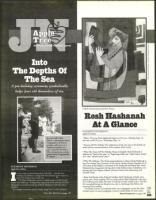
A Rosh Hashanah postcard from France.
Rosh Hashanah
At A Glance
(41
ELIZABETH APPLEBAUM
AppleTree Editor
Beverly Hills' Molly
liarris, a Reconst•uctionist
Congregation of Detroit
niember, takes part in a
Taslilich ceremony last
year at the Detroit River.
This ceremony was jointly
sponsored by Congregation
Trhiyah.
ELIZABETH APPLEBAUM
AppleTree Editor
it
must make an interesting day for the fish — Jewish men,
women and children, tossinc, b little bits of bread in the water on
U
one of the holiest days of the year.
This Rosh Hashanah custom is called tashlich, which literally
means "you shall cast." It begins late afternoon on the first day of Rosh
Hashanah, or on the second day of Rosh Hashanah if the first day is
Shabbat.
It's a simple ceremony: people simply assign "sins" to bits of bread,
INTO THE DEPTHS to
page 147
• When: This year, Rosh Hashanah begins at 7:21 p.m., Monday, Sept. 17,
and lasts until 8:19 p.m., Wednesday, Sept. 19.
• Purpose Of The Holiday: The celebration of the new year on the Jewish cal-
endar and the commemoration of the creation of the world.
• What The Name Of The Holiday Means In English: Rosh Hashanah is
Hebrew for "head of the year," or "beginning of the year." (Rosh means "head,"
ha is "the," shanah means "year.'')
• Why We Celebrate: The Torah commandment to observe Rosh Hashanah is
found in Parshat Emor (Leviticus 23:24) and in Parshat Pinchers (Numbers 29:1).
The name of the holiday is not stated in the Torah; this developed later. Rosh
Hashanah also inaugurates the big, three-week holiday season in Judaism, con-
tinuing with Yom Kippur, Sukkot, Shemini Atzeret and culminating with
Simchat Torah.
• Rites And Rituals: Like all Jewish holidays, Rosh Hashanah includes extra
prayers and a Torah reading. What is unique about Rosh Hashanah is the prac-
tice of blowing the shofar, the horn of a kosher animal, usually a ram. The sho-
far is sounded during the Musafservice, that is, the liturgy that follows the
morning Torah reading.
The shofar is blown immediately before the congregation recites the silent
9/14
Amidah prayer. In most synagogues, everyone recites Psalm 47 seven times.
ROSH HASHANAH to page 146 141
Scanned image of the page. Keyboard directions: use + to zoom in, - to zoom out, arrow keys to pan inside the viewer.
September 14, 2001 - Image 153
- Resource type:
- Text
- Publication:
- The Detroit Jewish News, 2001-09-14
Disclaimer: Computer generated plain text may have errors. Read more about this.