
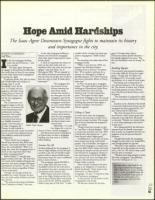

Hope Amid Hardships
The Isaac Agree Downtown Synagogue fights to maintain its history
and importance in the city.
As the only synagogue building in
Detroit, the Downtown Synagogue
often helps dispel misperceptions about
Jewish people.
t's the last synagogue building
"I think it's important that those we
within the city of Detroit — and
meet on the street, [who are] not
it's in trouble.
exposed to Jews, can come into our syn-
The Isaac Agree Downtown
agogue," says Jack Felsot, 59, of
Synagogue is facing financial difficulties
Farmington Hills. "We are exposed to
that could close its doors by next spring,
the African-American community and
yet the small, determined congregation
they see what we are like, that we like to
is putting up a fight.
have fun, pray to God. It breaks down
To generate funds, they plan an estate
stereotypes."
sale of collectibles and antiques on
The synagogue also
Sunday, Sept. 9, at the
has attracted young
Southfield Centre for the
African-American stu-
Arts. In October, the con-
dents from nearby
gregation will hold a fund-
schools who wanted to
raising dinner in honor of
see what goes on in the
Rabbi Noah Gamze, who
synagogue, says Martin
has led the congregation
Herman of Detroit, the
since 1963.
synagogue's ritual direc-
The Conservative con-
tor and a retired Wayne
gregation began in the late
State University profes-
1920s as a convenience for
sor.
Jewish businessmen and
'And visitors from out
professionals working
of town call us because
downtown who wanted
we're the only synagogue
somewhere to attend
listed in Detroit. Some
morning services and to
ask about Jewish events
say Kaddish (mourner's
around town. "
prayer). Over the years, as
Rabbi Noah Gamze
Adds Felsot: "It would
all other synagogues left
be a shame for a city our
Detroit, its role evolved to
size not to have a Jewish synagogue."
provide services and a sense of commu-
The Reconstructionist Congregation
nity to a much more disparate group
of Detroit does not have a synagogue
from different social and economic
building, but does meet in a Detroit
backgrounds.
office building.
"I don't think any synagogue
should stop because they don't have
money," says board member Carole
Services For All
Katz, 62, of Southfield. "Who is to
Another hallmark for the synagogue is
judge that what this synagogue does is
that its High Holiday services are open
more or less important than what
and free to all. The 275-family congre-
another synagogue does?"
gation swells to almost double its size,
Rabbi Gamze, 77, sees the syna-
becoming a haven for many unaffiliated
gogue's mission this way. "We still main-
Jews in metro Detroit.
tain much of the traditional liturgy and
The synagogue spends $10,000 to
practices, with some changes, like equal
rent a larger space (this year at the
participation of women," he says. "And
Southfield Centre for the Arts) and to
all Jews are welcome regardless of finan-
pay speakers' fees and to transport its ark
cial or social status."
and prayers books, Herman says.
Though not enough people are
Rabbi Gamze will return to partici-
available for a daily minyan, he says,
pate in the High Holiday services. He's
they do hold weekly Shabbat and holi-
been living in Rhode Island with family,
day services.
close to his ill wife. He'll be assisted by
I
"We welcome all streams of Judaism
Rabbi Craig Alan of Oak Park. "A rabbi
from Orthodox to liberal," Katz says.
SHARON LUCKERMAN
Staff Writer
I
couldn't ask for a kinder and more sup-
portive congregation," Rabbi Gamze
says.
He remembers the earlier days of the
synagogue fondly.
"When I came here [in 1963], our
services were held above Kosins
Clothing Store in Detroit," he remem-
bers. "If we needed a tenth guy for a
minyan, we 'kidnapped' a couple of
[Jewish] salesmen. Or if they were busy,
the owners themselves, Benny or Harry,
came over."
In 1962, the group got a synagogue
charter. The Agree family bought them a
building on Griswold and Grand River,
several blocks from then-thriving
Hudson's and Crowley's department
stores. Thus began the Isaac Agree
Downtown Synagogue, then one among
many in the city. The family named the
building after patriarch Isaac Agree, a
Russian immigrant who became a
Detroit engineer.
Filling A Need
In more recent years, the synagogue,
however, has attracted a number of sin-
gles and younger members. The average
age of service attendees has dropped to
45, says Felsot.
"Rough times have brought us clos-
er," says Katz, a clinical therapist. "We're
a community and that's why I go. We're
a family and a functional one — we're
there for each other's higher good."
Unaffiliated for more than 20 years,
Katz missed not being with Jewish
people. Once Orthodox, she began to
visit several synagogues a couple years
ago, but didn't find a home until expe-
riencing the people and the services at
the Downtown synagogue. Drawn to
the mixed group of Jews from differ-
ent cultures and races, she began hav-
ing fun. She joined and was on the
board within a month.
Felsot started working at the syna-
gogue as an obligation to maintain a
Jewish landmark. "Some work in the
Federation or Allied Jewish
Campaign," he says. "I wanted to help
the Downtown synagogue."
In the process, he was drawn to the
congregation and joined.
He also has a dream for the syna-
gogue. He hopes they create a
Downtown Detroit Jewish Museum —
he's already.registered the name. "But
first our foundation must be strong," he
says.
Building Repairs
The economic and physical foundation
is the other difficulty facing the congre-
gation. Though they own their own
building and it's "structurally sound,"
says Herman, it's in need of much repair.
The heating and cooling system is
very old and expensive to fix, for exam-
ple. The elevator is broken and, if fixed,
could help generate income, Herman
says. The third and fourth floors could
be rented.
"The Federation is supposed to make
a loan to reconstruct the elevator," Felsot
says.
Jonathan Lowe, director of the Jewish
Community Endowment Fund, says the
synagogue has been approved for a 10-
year, interest-free $75,000 loan.
"But that's the least of our worries,"
says Herman, who's written grants and
proposals to get help from the Jewish
community "Despite our modest budg-
et, we've been operating in the red for
several years."
He is disappointed by the lukewarm
response from the Jewish community.
But, he adds, he recognizes that the con-
gregation must also pursue financial
solutions.
Though historically the synagogue
charged no dues, they now charge $60 a
year, though people can pay less.
"We need to stay together," says Katz,
"especially given that people are moving
back to the city. We need to keep a place
here for Jews to worship."
"We don't have deep pockets or trusts
like other synagogues," says Herman,
"but we're working on it." O
eitate sale to raise funds for the
sa Agree Dovvntown Synagogue
.be held 10 a.m.-5 p.m. Sunday,
t. 9, at the Southfield Centre for
the Arts, Southfield Road, south of
Mae. For information or to
e a donation, call (313) 961-
928.
8/31
2001
51