
American Heart
Associations.
Health
Fighting Heart Disease
and Stroke
The Most
Important
Instrument in
the Treatment
of Stroke
RUTHAN BRODSKY
Special to the Jewish News
Jr
ews and medicine throughout
modern history will be the
subject of a two-day confer-
ence May 6-7.
The event, at Temple Shir Shalom
in West Bloomfield on Sunday
evening, May 6, and at Wayne State
University on Monday, May 7, is
sponsored by WSU's Cohn-Haddow
Center for Judaic Studies and the
©1995. American Heart Association
SEND
SOMEONE
SPECIAL
A GIFT
52 WEEKS
A YEAR
z
z
z JN
z
.
tors, for example, were the first Jews
permitted to attend the University of
Padua, Italy, entering a profession pre-
viously restricted from them," says
Ruderman. "Many Jews responded to
the opportunity, including rabbis who
were able to carry out their dual
roles."
In addition to their medical skills, it
was these physicians who also brought
non-Jewish culture to the Jewish ghet-
tos of Italy. "The Jewish Doctor as
Cultural Mediator: Reflections on the
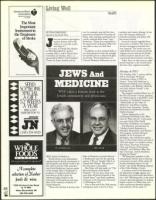
JEWS And
MEDICINE
WSU takes a historic look at the
Jewish community and physicians.
SEND A GIFT
SUBSCRIPTION TO
DETROIT
JEWISH NEWS
(246) 354-6620
WH-OLE
FOODS
WIENIFIED
It&i‘e peat tastiO iod Ai' o4 irattu-ae
LA complete
selection of Kosher
foods Sz wine.
5/4
2001
96
7350 Orchard Lake Road
at 14 Mile
West Bloomfield, MI
248-538-4600
David Ruderman
Elliot Doiff
WSU School of Medicine.
"Jewish doctors were ambassadors
representing the Jewish community to
the European non-Jewish world in the
late 16th to the late 18th centuries,"
says David Ruderman, keynote speak-
er for Sunday, May 6. Ruderman is
professor of modern Jewish history
and director of the Center for
Advanced Judaic Studies at the
University of Pennsylvania and presi-
dent of the American Academy of
Jewish Research.
"Those who decided to become doc-
Place of Medicine in Jewish History"
is Ruderman's topic for the opening
session, 7:30 p.m. Sunday, May 6, at
Temple Shir Shalom. The session is
free and open to the public.
Alan Kraut will also speak, on "The
Rise and Demise of the Jewish
Hospital." "At one time, there were
more than 60 Jewish hospitals in the
United States," says Kraut, professor
of history at the American University
in Washington, D.C.
Prior to the end of the 19th century,
immigrants came to the U.S. from
northern and western Europe. In the
late 19th century, millions of
Catholics and Jews and others with
less money arrived.
American nativists regarded these
newcomers as inferior. The result was
the later immigrants founded their
own hospitals. The Jewish ones pro-
vided kosher food, conducted Jewish
religious services and served Jewish
medical students and doctors who
encountered discrimination elsewhere.
Today, there are only seven or eight
Jewish hospitals in the United States
that have their original ownership.
Monday At WSU
The Monday, May 7, sessions will be
held at McGregor Memorial
Conference Center at WSU in
Detroit. "From Folk Medicine to
Professional Medical Care: Healing
and Health in the Biblical, Medieval,
and Early Modern Periods" is the
morning theme.
The program includes Efraim Lev of
Bar-Ilan University in Israel, speaking
on "Medical Issues in the Bible"; Lenn
Goodman of Vanderbilt University,
"Maimonides on the Value of
Medicine"; and Allison Couder,
Arizona State University, "Jewish
Physicians and Alchemists in Early
Modern Europe."
"Jewish Approaches to the
Distribution of Health Care: Who
Gives It? Who Gets It?" is the lunch-
eon topic led by Elliot Dorff,
University of Judaism, Los Angeles.
The afternoon concentrates on
"Modern Jewish Responses to
Prejudice, Persecution, and Disease."
The program includes Howard
Markel, of the University of
Michigan, who will discuss typhus
fever on New York's lower east side in
1892 and apply it to modern events;
Alan Kraut, American University,
"Rise and Demise of the Jewish
Hospital"; and Miriam Offer, Bar-
Ilan University, "Jewish Medicine
During the Shoah."
"We bring these speakers to the
metropolitan Detroit area so that our
community is aware of the variety of
Jewish scholarship there is in the
world," says David Weinberg, director
of the Cohn-Haddow Center.
A common motif of the lectures is
the physician's struggle against anti-
Semitism and institutional discrimina-
tion. And, Weinberg adds, as the trend
toward a spiritual approach to healing
begins to grow, it is likely that even
more connections between Judaism
and medicine will be made.
❑
Scanned image of the page. Keyboard directions: use + to zoom in, - to zoom out, arrow keys to pan inside the viewer.
May 04, 2001 - Image 119
- Resource type:
- Text
- Publication:
- The Detroit Jewish News, 2001-05-04
Disclaimer: Computer generated plain text may have errors. Read more about this.