

Friends Across The Divide
Teens from opposite sides of the Middle East conflict speak out for peace.
DIANA LIEBERIvIAN
Staff Writer
T
he neighborhoods where Aviv Liron, 18,
and Amer Kamal, 19, grew up are only
about 90 kilometers from each other.
That translates into 54 miles, about as
far as from Mt. Clemens to Ann Arbor.
But Liron, an Israeli Jew from Bet Yitzchak, near
Netanya, and Kamal, a Palestinian from eastern
Jerusalem, would probably never have met while at
home. And, if they had, it might have been on
opposite sides of a street battle.
It took Seeds of Peace, a non-profit, non-political
organization based in the United States, to bring
them together. Since 1993, more than 1,500 teens
from Israel and 11 other Middle Eastern countries
have attended the Seeds of Peace International
Camp in rural Maine.
The experience has been life-altering.
"When my father was my age, he went to Jordan
to fight," Liron told students at West Bloomfield
High School last week. "I've been [to Jordan] twice
to visit my friends. I took my passport; I ate there; I
slept there. That opened my father's eyes."
The two young men, in Detroit April 5-9 with
Rami Nueir, Seeds of Peace outreach coordinator,
and Michael Wallach, director of special projects,
were on the go morning until night, spreading the
word about the organization.
They spoke to students at Dearborn High School
and at Oakland International Academy in
Farmington Hills. They also gave presentations to
the Arab American Chamber of Commerce, Jewish
Community Council of Metropolitan Detroit and at
Congregation Shaarey Zedek, the Southfield
Ramada Inn and Neiman-Marcus department store
in Troy.
The delegation then left for a similarly hectic visit
to Los Angeles.
Personalizing The Enemy
"The purpose of Seeds of Peace is to break down
barriers and show the enemy has a face," said Daniel
Horwitz of West Bloomfield. Horwitz, 17, is one of
a handful of American teens — and the only
Michiganian — to attend the summer program as a
camper.
For nearly a month, Seeds of Peace campers,
known as "seeds," bunk together, eat together and
play on the same teams.
Kamal, who attended Seeds of Peace camp in
1997 and 1998, emphasized the grueling 90-minute
conflict resolution sessions "seeds" go through each
day.
4/20
2001
Is
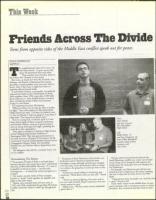
Above
Amer Kamal
and Aviv Liron at
West Bloomfield
High School
Left:
Shelly Kitain, 17,
and Sara Chadwick, 16,
both of West Bloomfield,
examine Seeds of Peace
literature with
Aviv Liron.
His group of three Palestinians, four Israelis, two
Jordanians and an American stayed the same
throughout camp, although its facilitators changed
every two days. Once the facilitator picks an image
or a subject, the group has to come up with its own
solution.
"If someone started yelling or something, they
would say, 'Think about what you just said,"' Kamal
said.
"There's no physical fighting. You want to do it,
but you catch yourself. People would leave the coex-
istence session in tears."
Added Liron, "We have pretty intense basketball
games after it."
Horwitz said he had previously believed the
Israeli/Palestinian conflict was a clear case of right
versus wrong. Even though he still supports the
Israeli cause, the camp gave him new empathy for
the Palestinians.
For example, one Palestinian girl told her new
friends how she couldn't go to her sister's wedding:
she lives in Gaza and her sister lives in the West
Bank.
"I learned that these are people, too, and they have
a cause," Horwitz said.
Once "seeds" return to the Middle East, the pro-
gram continues with a coexistence center in eastern
Jerusalem. But coexistence has been hard to main-