

an office in L.A.," notes Stern, who
plans on producing more films while
keeping active on the Broadway circuit.
"I will be coming to New York
often, but two offices
Chicago and
Los Angeles — are enough."
His wife, Kathryn, and their two chil-
dren, ages 5 and 2, live in Chicago,
keeping Stern grounded in the Midwest.
Kathryn, a writer, had her first novel,
Another Song About The King, about an
evolving mother-daughter relationship,
published last year by Random House.
The daughter of West Bloomfield resi-
dent Page Glasgow and the late
Jacqueline Weill Glasgow, Kathryn grew
up in the Detroit area, attending Pierce
Elementary in Birmingham, Orchard
Lake Middle School and West
Bloomfield High School, from which
she graduated in 1979. She went to reli
gious school at the Birmingham Temple.
Although Kathryn attended
University of Michigan, she met her
future husband in New York. The cou-
ple were introduced by New York-
based writer Susan Shapiro, also a for-
mer West Bloomfield resident.
In his work and daily life, says (.tern,
who was raised in an observant Jewish
home, Judaism is the foundation. "It's
what I do, how I think and who I am,"
he says. "And I am raising my kids
Jewish
that's very important to me."
The Sterns belong to K.A.M. Temple
in the Hyde Park area of Chicago.
Presently, Stern is working on an
IMAX film with the people who made
Stomp, the Off-Broadway show that
focuses on sounds. "Right now they
are collecting sounds from all over,
and when we are finished, it will be a
Stomp-ish performance," he says. "The
name of the film is Pulse, and it
should be out next year.
But with The Producers officially
opening on April 19, Stern's focus is in
New York. "I have seen the show at
least 30 times, and I laugh hard each
rime," he says.
"But there will be nothing like
opening night, and we are all looking
forward to it. I am sure The Producers
will be around for a long time." ❑
The Producers, currently in pre-
views, opens Thursday, April 19,
at the St. James Theatre, 246
West 44th Street, in New York
City. Performances are 8 p.m.
Tuesdays-Saturdays, 2 p.m.
Wednesdays and Saturdays and 3
p.m. Sundays. 530-590. Tickers
are available in person at the St.
James Theatre box office, or call
Tele-charge at (212) 239-6200.
Brooks' Broadway Baby
Mel Brooks and his creative team reflect on the musical-stage
version of "The Producers."
PAULINE DLTBKIN YEARWOOD
The Chicago Jewish News
IVI
el Brooks, Matthew Broderick,
Nathan Lane, Susan Stroman
and Thomas Meehan are late. They're
keeping the press waiting in the lobby
of Chicago's Cadillac Palace Theatre.
Then they appear, walking onstage in
a row, two famous actors, a famous cho-
reographer/director and a writer. And, of
course, a man that some people think is
the funniest person in America.
Mel Brooks, instead of filing in with the
others to the chairs set up on the stage,
detours to the microphone. He grabs it
and says, in the intonation of a Borscht
Belt comic: "Two Jews got off a bus ..."
The place cracks up.
It isn't that the line is so funny, it's
just that — well, Mel Brooks has spent
a lifetime cracking people up, and at
74, he knows just how to do it.
When the laughter finally subsides,
he continues: "... and one Jew said to
the other ..." — provoking a fresh
round of hilarity.
The Producers, the new Mel Brooks
musical adapted from his 1968 movie of
the same title, was what Brooks,
Broderick, Lane, et. al., were in Chicago
to talk about, almost to justify, although,
of course they didn't use that word.
The Producers, which departed the
Cadillac Palace at the end of February
to prepare for its Broadway run, is per-
haps the first new musical in recent
memory that requires any justification.
It isn't the first movie to morph into
a musical-stage play. Big, The Full
Mono/ and The Lion King are recent
examples — the latter imaginatively
altered in the process and receiving
tremendous praise.
But The Producers is no Disney movie.
Rated 11th in the American Film
Institute's ranking of the all-time greatest
film comedies, it's a prime example of
Brooks' signature mix of shtick and
satire, frantic physical comedy and paro-
dy of established film genres.
Brooks won an Academy Award for
best original screenplay for The
Producers (he wanted to name it
Springtime for Hider but too many film
executives, many of whom were Jewish,
thought Jews would be offended).
The movie went on to become a clas-
sic with a huge cult following, a sort of
Jewish Rocky Horror Picture Show.
It was the first major film success for
Brooks (born Melvyn Kaminsky), who
started his comedy career doing standup
in the Catskills, then became a writer
for one of television's earliest hits, Sid
Caesar's Your Show of Shows. He went
on to continued success with 1974's
Blazing Saddles and Young Frankenstein.
In 1960 and '61, he teamed up with
Carl Reiner to write and perform a
series of comedy albums beginning
with The 2000 Year Old Man. In 1997,
he and Reiner reprised their success
with the Grammy-winning The 2000
Year Old Man in the Year 2000.
In film, Brooks went on to write and
star in High Anxiety in 1977, Spaceballs
in 1987 and Robin Hood. Men in
Tights in 1993, among others. He won
three successive Emmy Awards for his
role as Uncle Phil in the popular TV
sitcom Mad About You.
Yet all this time, to hear the people
responsible for the current production
tell it, there were forces afoot in the
world who would not rest until The
Producers was made into a musical.
"People have been asking for 30 years
when someone was going to make this
into a musical," said Stroman, the
multi-award-winning choreographer of
the musical Crazy for You and director
and choreographer of last year's
Contact.
And that's what happened, apparently
after DreamWorks executive David
Geffen convinced Brooks that he
should make the attempt.
To write the book he teamed up with
Thomas Meehan, who won a
Tony Award in 1977 for
writing the book of
Annie and worked with
Brooks on the screen-
plays of Spaceballs and
To Be or Not to Be.
The songs are by
Brooks — "He's been
writing songs all his
life," according to
Meehan.
The play does
not follow the
movie to the let-
ter, the assem-
bled company
let it be
known.
There are
new songs
and some new
characters, and
one old one — the actor known as
LSD, played by Dick Shawn — has
been cut.
The biggest difference between the
two vehicles, according to Meehan, has
to do with the difference between stage
and screen. "All the emotional events
have to be played bigger because you
don't have the close-ups," he said.
He also acknowledged that some die-
hard fans of the movie might not like
the idea of it being turned into a musi-
cal, though they would surely like the
production itself
Stroman said that when the play was
being workshopped in New York, "peo-
ple who saw it told me they had to take
aspirin because their cheeks hurt from
laughing so much."
As for the choice of Broadway
favorites Lane and Broderick, Brooks
had this to say:
"We really couldn't get who we want-
ed." (Loud audience laughter.)
To wrap up, all say how lucky they
are to be involved in this "dream pro-
duction."
Stroman describes how Brooks
waltzed into her apartment singing
one of the songs from The Producers
at the top of his lungs, and Brooks
somehow works his way through a
convoluted metaphor about Lane's
acting being like a cinnamon bun.
In response to a question about the
possible insensitivity of a show-with-
in-a-show that glorifies Nazis,
Meehan responds that Brooks' answer
to Nazism and the Holocaust was "to
ridicule Hitler."
Brooks jumps in. "What can I tell
you?" he says. "My job was to make
Nazis cute! To make Jew-killers
adorable!"
If anybody can do it ... E
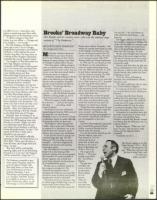
Mel Brooks singing in his film
"High Anxiety" (1977). Of his
musical 'The Producers," he
says, "What can I tell you? My
job was to make Nazis cute!
To make Jew-
killers adorable!"
4/13
2001
69