

And The Plays
Go On num
The Producers is not the only show
on the New York stage with a Nazi
theme. Cabaret and The Sound of
Music are long- running musicals
set during the rise of Nazi
Germany..Below are some new
plays in the Big Apple that deal
with the Holocaust or the Nazi era:
• Judgment At Nuremberg, by
Abby Mann and produced by
Tony Randall's National Actors
Theater, is set in 1948 in
Nuremberg, Germany. Based on
the second set of trials held to
prosecute Nazi war criminals, the
cases concern the judges and legal
officials who were tried for acts of
inhumanity. The cast of 21 is led
by Maximilian Schell, who won
an Oscar as Best Actor in the
motion picture version of the play.
Performances are at the
Longacre Theater, 220 West 48th
St. $29.50-$75; (212) 239-6200.
• The Gathering, by Arje Shaw,
stars Hal Linden and is a controver-
sial political drama about Ronald
Reagan's 1985 visitto Bitburg, a
German cemetery where Nazi sol-
diers are buried. Reagan's act causes
conflict among three generations of
an American Jewish family, who
have differing opinions on the
issue. The conflict reaches its peak
and resolution at the German
cemetery, where grandfather, father
and grandson, who is studying for
his bar mitzvah, wind up meeting.
It begins previews April 13 and
opens April 24 at the Cort
Theater, 138 West 48th St. $30-
$65; (212) 239-6200.
• The Garden of Frau Hess, by
Milton F Marcus, is presented by
the Jewish Repertory Theater and
takes place in 1944 Germany.
Fictionalized but based on actual
events, its about the relationship
between use Hess, wife of Nazi Party
leader Rudolph Hess, and Isaac
Baum, a concentration camp prison-
er who is a former professor of horti-
culture and becomes Hess' gardener.
Previews begin April 21 and
opening night is April 29 at the
Duke Theater, 229 West 42nd St.
$40-$45; (212) 239-6200.
— Alice Schweiger
4/13
2001
68
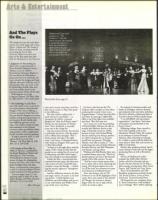
Nathan and Lane and
company in "The -
Producers." Like the
movie version, the musical
is politically incorrect,
with the potential to
. offend Jews and gays:
!Witt 1 think people will
take it the right- way,."
• says producer Jim Stern. - .
DORI ftymia'
ADD SUPVMSED ternCtiVi.t.
MAx
PRODUCERS
from page 65
raise more money than they need for a
play that is certain to flop, then pock-
et the difference.
The play-within-a-play's title —
need anyone be reminded? — is
Springtime for Hitler, a musical
designed to "clear the Fiihrer's name."
Written by the character of "former
Nazi" Franz Liebkind, it naturally
turns out to be a huge hit.
Like the motion picture, the musical
is politically incorrect, with the poten-
tial to offend Jews and gays. "But I
think people will take it the right
away," says Stern, a Chicagoan whose
wife, Kathryn Glasgow Stern, grew up
in West Bloomfield.
"Its heart is in the right place, and that
makes it OK. I think it's clear that the
people we are making fun of, we are real-
ly embracing, and that's what's impor-
tant. The comedy is not mean spirited."
Unlike the film, a nonmusical that
contained several songs, this show pro-
vides a bevy of witty vaudeville-type
numbers written by Brooks — includ-
ing the movie's signature "Springtime
for Hitler."
Another difference between the film
and stage version, of course, is its lead-
ing players. "I think Nathan and
Matthew are both brilliant and go toe
to toe with Mostel and Wilder every
step of the way," says Stern.
For Stern, who first saw the The
Producers while a student in Ann Arbor,
producing the musical version was a
longtime dream. "I always loved the film
and about six years ago I called Mel's
office to see if the rights were available,"
says Stern. "But they were not.
"As it turns out, with the prodding
of David Geffen, Mel got the idea to
transfer this fabulous movie to the
stage. Ultimately, however, Geffen
became so busy with DreamWorks
that he ended up not being a produc-
er, which was great for us, because
myself and my partner, [Douglas
Meyer], were able to jump in." The
producing team also includes Miramax
founders Harvey and Bob Weinstein
and Brooks, among others.
Working with Mel Brooks, Stern says,
is another dream come true. "Mel is an
absolute genius and one of the funniest
people of the 20th century," he says.
"And he is even a better person than
he is a talent. He is warm, charming and
caring. Like all great talents, he is not
`on' all the time, but whenever he wants
to be funny, he is brilliantly funny."
Stern says being a part of The
Producers is one of the highlights of his
career. Born and raised in the suburbs
of Chicago, his interest in theater
began when he was in high school,
where he acted in plays.
He majored in American studies and
theater at Michigan, where he directed
and produced some nine plays, including
Man of La Mancha, Cabaret and How to
Succeed in Business Without Really Tying.
"I ran MUSKET, the big student
organization," says Stern, "and some
of my plays were performed at the
Power Center."
Following college, Stern moved to
New York, landing a job at the
Manhattan Theater Club. He worked
as an assistant to lyricist Howard
Ashman. After returning to Chicago
for a while to work with his father, he
came back to New York and earned an
MBA at Columbia.
Shortly after graduate school, Stern's
career started to take off, and he began
producing films as well as Broadway
shows.
His list of Hollywood credits
includes the IMAX film Michael
Jordan, which he directed and pro-
duced. He also directed Its the Rag, a
dark comedy starring Joan Allen, Anna
Paquin, Jeff Daniels and Gary Sinise.
Some of his Broadway and Off-
Broadway productions include Stomp,
The Sound of Music, Diary of Anne
Frank and Communicating Doors.
He formed his own company, James
D. Stern Productions, with headquar-
ters in Chicago. "But I will be opening