

Community
Spirituality
Modern-Day Shushan
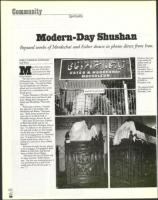
Reputed tombs of Mordechai and Esther shown in photos direct from Iran.
SHELLI LIEBMAN DORFMAN
Staff Writer
M
arc Konvisser remem-
bers one of the first
conversations he had
with his good friend
Hadi Rabbini.
"He told me he came from the city
of Hamadan in Iran," says Konvisser
of Orchard Lake. "He said his father
was the headmaster of a Muslim
school and he remembers that across
the street was a mausoleum with
Jewish graves.
"I knew Hamadan is Shushan (site
of the Purim story) and that he had
to be talking about the graves of
Esther and Mordechai," Konvisser
says.
"Every year at Purim, I remind
him that this is the holiday with
Mordechai and Esther," Konvisser
says. "Hadi always promised that
some day he would go back to
Hamadan and get pictures for me."
More than 20 years later, Rabbini
of West Bloomfield and his two
brothers, also from Michigan, did just
that. "In addition to the pictures of
the [reputed tombs], he also brought
one he said was of a funny gazebo
with fruit hanging from it," Konvisser
says. "A guard told him his Jewish
friends would know what it was. I
looked at it and saw it was a sukkah
(booth)."
Konvisser brought his new photos
to his synagogue, Congregation Beth
Shalom in Oak Park, and showed
them to Rabbi David Nelson.
"We know the story of Purith and
we have carnivals," Rabbi Nelson
says. "But this was amazing because it
was something from a part of the
world most of us will never get to
see." ❑
3/2
2001
50
Clockwise from top:
A sign marks the
reputed tombs of
Esther and
Mordechai in
Hamadan, Iran, a
city once known as
Shushan.
The supposed tomb
of Esther in
Hamadan, Iran.
The supposed tomb
of Mordechai in
Hamadan, Iran.