
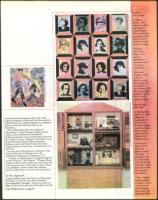

Clockwise
from top right:
In "Russian
Matrix," 1994,
silkscreen on fabric
and acrylic on
canvas, Schapiro
fills the grid with a
genealogy of artistic
female ancestors,
including her own
portrait in disguise.
"Dollhouse
(with Sherry
Brody), 1972;
made for
Womanhouse;
three-dimensional
construction,
mixed media.
"Father and
Daughter, 1997,
acrylic and
fabric on canvas,
acknowledges the
artist's father's
role as mentor: "I'm
also running ahead
of him and leading
him in a way,"
explains Schapiro.
U
O
00,
'Opposite page,
left to right:
-Of
started women thinking about how they could
express themselves as artists and how that would be
called feminist art," explains Schapiro in a telephone
interview from her New York home in the
Hamptons.
Their collaboration led to the creation of
Womanhouse, in which Chicago, Schapiro and 21
women artists transformed an abandoned
Hollywood-mansion into an environmental piece by,
for and about women. Schapiro's contribution was a
three-dimensional mixed media construction,
Dollhouse, made with Sherry Brody, which chal-
lenged traditional notions that a woman's place is in
the home.
It is now part of the permanent collection of the
National Museum of American Art at the
Smithsonian Institution in Washington, D.C.
"I express my feelings about the world through the
content of my art," says Schapiro. "Whatever choice
I make in subject matter always has something to do
with women: women as they relate to men, women
as householders, women as they have children,
women as they relate to women artists in the past."
A New Approach
Schapiro helped launch the Pattern and Decoration
Movement in the '70s, when she invented her
groundbreaking "femmages," feminist-oriented col-
lages of fabric and acrylic paint that explore and cele-
ART OF BECOMING on page 89
In 'Autobiography"
1959, oil on canvas,
Schapiro lays
the groundwork
for later themes:
the mother-daughter
bontZ the ambiguous
fractured image
neither male nor
female and the
ovoid egg shape.
"Lady Gengi's
Maze," 1972;
acrylic and
fabric on canvas.
"My whole
development was
as a mainstream
artist and the shift
came when I began
to put cloth on the
face on canvas,"
says Schapiro.
"Time," 1988-91,
acrylic and fabric
on canvas, is one of
several works in
which Schapiro
pays tribute to the
artist Frida Kahlo.