

Arts & Entertainmen
FRAN HELLER -
Special to the Jewish News
I
n a large autobiographical triad of paintings,
New York feminist artist Miriam Schapiro
portrays an emerging woman artist at differ-
ent stages of development.
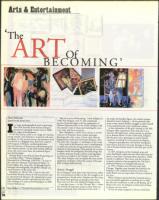
In the first canvas, there is an image of a faceless
young woman, torn between a maternal and pater-
nal figure. In the second canvas, the tentative artist
is pictured as a Raggedy Ann doll with a palette
and bouquet of flowers, vacillating between
expected notions of femininity and becoming her
own creative person. In the third canvas, Moving
Away, the artist turns from the maternal figure
into the ,limelight.
Moving Away is one of more than 30 paintings in
a traveling exhibit, "Miriam Schapiro: A
Retrospective of Paintings 1954-1997." It stops at
the Lowe Art Museum, University of Miami, in
Coral Gables, Fla., from Feb. 22 through April 8.
Arranged chronologically, the exhibit emerges as a
visual narrative of the artist's life.
Schapiro's art, like her life,, is not an easy read.
Laced with feminist theory as well as personal, artis-
tic and historical allusions, the representative paint-
ings nonetheless provide a glimpse into the mind
and workings of a major pioneering figure in 20th-
century feminist art.
al(
2/16
2001
76
Fran Heller is a Cleveland-basedfreelance writer.
"My art is an art of becoming," wrote Schapiro in
1996. For Schapiro, now 77, that continuous
process of growth began with her exploration of
Abstract Expressionism in the 1950s. Schapiro calls
that period a time of chaos and searching for struc-
ture, color and form on canvas.
Fetes Champ'etres, a 1954 oil on canvas, is consid- ,
ered one of Schapiro's finest earliest paintings.
Bursting with color, many of these early Abstract
Expressionist works have landscape allusions, what
the artist calls "inscapes" or landscapes of the mind.
A key work in the formative years is Autobiography,
in which the artist lays the groundwork for themes
explored in later paintings. These include the mother-
daughter bond; the ambiguous, fractured image that
is neither male- nor female; and the ovoid egg shape,
an important symbol in the "Shrine" series of the
'60s, when Schapiro starts to explore her own autobi-
ographical vocabulary within the context of the past,
both symbolic and historical.
Artistic Struggle
All of Schapiro's work deals with what she has called
her most profound conflict in life: the struggle to be
recognized as a female artist. Schapiro says her strug-
gle comes from growing up during a time when
there were very few role models for female artists.
It was also a time — in the '50s and '60s — when
the network of important artists in New York was
almost exclusively male. Elements in her work —
the mask, the headless figure, the creative woman
dressed in men's clothing — all are painterly allu-
sions to the creative female's struggle to assert herself
in the predominantly male intellectual culture.
In her exploration of the grid, starting in the '60s,
Schapiro takes a geometric form and uses it as a
basis for self-exploration, which reaches its apotheo-
sis in Russian Matrix. In this 1994 work, Schapiro
fills the grid with a genealogy of artistic female
ancestors, including her own portrait in disguise.
Schapiro's grandparents were Jewish immigrants
from Russia and this work pays homage to them as
well as Russian female artists in the early part of the
century.
In 1967, Schapiro and her husband, artist and
writer Paul Brach, whom she met when both were stu-
dents at Iowa State University (they married in 1946),
moved to California. That move, and the incipient
women's revolution that emerged in the '70s, had a
profound influence on Schapiro's life and art.
In 1971, Schapiro met feminist artist Judy
Chicago. Together, they founded the Feminist Art
Program at the California Institute of the Arts,
where Brach was serving as dean of the art school at
the time.
When Schapiro approached her husband about a
new and radical approach to teaching art, he told
her that she would have to talk to the faculty, all of
whom were men. So Schapiro invited each of them
to dinner, one at a time.
"It was the major program, in the art world that