

aqL •
Lizaro S plants anc monkeys nelo stucents at
Yes nivat Kiva learn aoout the rain forest.
Elizabeth Applebaum
AppleTree Editor
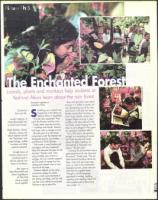
Clockwise
from top left:
Aviela Weltman of
West Bloomfield tries
to smell some Powers.
Phyllis Rochen, Akiva's
librarian, along with
others helped to build
the "Rainforest" with
paper foliage, stuffed
monkeys and other
creative materials.
Mirelle Mann of
Franklin checks out a
rainforest book in
Akiva's pseudo rain-
forest in the library.
Ben Luger of
West Bloomfield and
Adina Applebaum
of Oak Park
share a jungle
book together.
S
omething very unusual was
happening in the library of
Yeshivat Akiva in Southfield.
First the trees appeared. Then
came the flowers and the vines.
Finally, there were the animals
— monkeys and lizards, toucans
and frogs, even a cougar or two.
All were part of a rain forest,
constructed under the direction of
third-grade teacher Lynn Farber
and librarian Phyllis Rochen.
"We came in one Sunday and
just began with four carpet-roll
tubes that became the trees for the
structure," Rochen said. Then,
using invisible wire to form a
canopy, the two women suspend-
ed 25 yards of netting from the
ceiling and looped vines in and
around all the trees.
Students helped out by using
construction paper to create
leaves, which were attached to
the netting and trees, and by mak-
ing their own colorful tissue-paper
flowers to use as plant life.
Boys and girls also were asked
to bring in a stuffed or plastic ani-
mal representing any of the crea-
tures found in the real rain forest.
Rochen reports that "monkeys, tou-
cans, frogs, lizards, snakes and
cougars began arriving in great
numbers and were placed in the
rain forest, some hanging from the
trees or camouflaged in the green-
ery, giving an authentic effect."
For a final touch, the teachers
brought in a recording of actual
rain forest sounds and turned
down the lights, creating "an
atmosphere of tranquility and
peace," Rochen said.
"Creating this environment was a
great experience for the class and
the school," Farber said. "The stu-
dents learned hands-on about the
trees, vines and rain forest crea-
tures, as well as the relationship
between humans, plants and ani-
mals that live together there.
Through a whole language
approach of writing, reading,
reporting and creating, these chil-
dren experienced a fascinating
new world." ❑
2/1C
200
67