

Entertammen
in Artie Shaw's All-American All Star Band, the offi-
cial jazz band for the U.S. Navy. After the war, he
toured the country with the likes of bandleaders
Gordon "Tex" Beneke, Bob Chester, Buddy
Morrow and Benny Goodman, and singers ranging
from Frank Sinatra to Harry Connick Jr.
Not bad for the former Leb Max Pitcowitz, whose
musical career started when he learned the man-
dolin in a local Workmen's Circle orchestra.
Now 80 years old, Mack Pitt continues playing
jazz and klezmer. Recently, he was bandleader and
performer at the Balfour Concert, sponsored by the
Zionist Organization of America, Metro Detroit
District.
Whatever the occasion, one of Pitt's trademarks is
Begin the Beguine, the tune most often associated
with Artie Shaw.
The Jazzman Remembers
Jazzman
Ken Burns' "Jazz" series reminds local musician of
his days with Artie Shaw and other jazz legends.
DIANA LIEBERMAN
Staff Writer
Pitt was 16 years old in 1937, when
11/Iack
he told his parents he wanted to quit
school to become a full-time musician. If
it didn't work out after one year, he promised he'd
come back home and finish high school.
"The principal told my parents, 'Leave him, he
wants to play If he wants to continue [his. educa-
tion], he'll come back,"' Pitt said. "I was lucky I
had such an understanding principal."
Almost immediately, Pitt was taken on by the big
bands, playing nightclubs, musicals and movies. In
the midst of the Depression, he earned $150.a
week.
Eventually, he proved his high school principal
right. It took about 20 years, but Pitt earned a high
school equivalency degree, followed by both a bach-
1/19
2001
78
elor's and master's degree
from Wayne State
University.
He worked 31 years in
the Detroit Public
Schools as a high school
music teacher, band
director and guidance
counselor, ending his
education career as the
assistant principal at
Osborn High. He also
continued to lead the
Mack Pitt Orchestra,
playing at local Jewish
and secular events.
But before settling
down, he spent World
War II playing lead sax
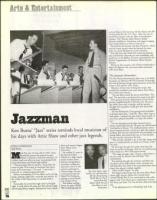
Top: Artie Shaw, right,
conducts his All-American
All Star Band during
World War II; Pitt is
second from left.
Above: Mack Pitt and
Artie Shaw in more
recent years.
The Ken Burns documentary Jazz, now in its debut
broadcast on Detroit's WTVS-Channel 56 through
the end of January, brings back memories of the old
times to Pitt and his wife, Dotty.
However; if they were writing the script, they
would have included a lot more about Artie Shaw,
Pitt's friend and mentor.
"No one did as much for me as Artie Shaw," Pitt
said. "No one had as much love for music as he did."
Pitt's parents owned a delicatessen in one of the
poorest neighborhoods in Newark, N.J. He was a
shy child, born with a harelip, and his parents
thought the mandolin would give him more self-
confidence.
"All the Workmen's Circle groups had mandolin
orchestras back then," said Pitt. "But, when I got a
little older, I realized the girls didn't think much of
you if you played mandolin, so I quit the orches-
tra.
Pitt ran through several other musical instru-
ments, mastering them all. He gave up cello because
"you had to sit funny." He tried percussion instru-
ments because he had a crush on a girl who played
cymbals. But then he noticed she was interested in a
young fellow who played alto sax, so Pitt decided
the sax was the instrument for him.
"The minute I picked it up, it was like, bang, this
was it. I would practice as much as 10 hours a day,"
Pitt said.
He never got the girl, but some time later she
came to see him backstage while he was performing
with a band at a New York movie house.
"The stage manager said, 'There's a dame here to
see you, and she doesn't look half bad,'"-Pitt
remembered.
Pitt ducked through the curtains and there was
the object of his high school crush, married, but
still beautiful. She asked if he remembered her from
when they played cymbals together.
"How could I forget?" he said.
Pitt began performing with the Artie Shaw Band
about eight months before the United States
entered World War II, but continued to take other
gigs as well. Then Shaw got a commission to form
the Navy jazz band. Pitt was his first choice for lead
sax.
"I was playing Loews on Broadway and Artie