

are adamant that a U.S. State Department warning
against travel to Israel is misguided. A State
Department official last week said the agency has
never limited a travel advisory to a specific area, but
includes the entire country.
Amnon Lipkin-Shahak, minister of tourism and
transportation, said the year 2000 was a record year
for tourism to Israel. "It started in mid-1999
[because of the- impending peace agreement between
Israel and the Palestinians, and the Millennium cele-
brations] – there was a whole change in atmosphere."
He said tourism increased by 20 percent in 1999 and
was projected to go up 30 percent in 2000.
With the downturn caused by the intifada, Israeli
officials are hoping to break even for the year. "In a
matter of days" after the riots started in late September,
our numbers went down," said Lipkin-Shahak.
The downturn has cost 15,000 Israelis their jobs.
Lipkin-Shahak said his ministry is encouraging
Israelis to travel inside Israel, rather than vacation-
ing abroad. And American evangelical Christian
groups continue to arrive, but not in the same
numbers.
A shooting incident in Bethlehem on Dec. 3 – in
the West Bank – will dampen Christian tourism
during the Christmas season. "No one was hurt,"
said Lipkin-Shahak, "but how can people go there
now?"
What we saw in a week of hopping around the
country that took us from Jerusalem and Tel Aviv to
Haifa and Eilat was repeated scenes of normalcy.
While the people we talked with were concerned
about the continuing national issues such as the
future of the peace process, all stressed they had no
physical fear of the Palestinian uprising and that vis-
itors wouldn't either.
black-hatted Orthodox Jews.
Kleiman said El Al had dropped two or three of
its regular two dozen weekly flights from New
York and Newark. The airline projected 350,000
passengers for October, 240,000 in November and
220,000 in December, drops of 20-30 percent
from last year.
The airline has three Boeing 777s scheduled for
delivery in 2001, with one of the 400-passenger
crafts scheduled for Chicago to Tel Aviv service.
Haifa
Mayor Amran Mitzna waded into the heart of an
angry street demonstration in downtown Haifa in
October.
Escorted by Israeli Arab friends, the mayor talked
"
miracle, this big project of the Jewish people," he
said. "Holy places, shopping, laying on the beach,
famous places – they are all here.
"It is not what you see on TV," said Mitzna.
"Come now, come support us. It will help you
understand what it is to be a Jew."
Some of the journalists, staying in the Dan
Carmel Hotel, were awakened by what sounded like
gunfire. Tour leader Geoffrey Weill assured them
there had been no violence in Haifa that night. "It
would be self-defeating to bring people here if it
were not safe," Weill said.
The journalists remained skeptical until they heard
the same sounds while touring the 19 terraces of the
Baha'i gardens – it was the sounds of ships being
unloaded in Haifa harbor.
8
F
Jerusalem
Jerusalem, and all Israel, is experiencing a construc-
tion boom. New suburbs, new buildings are going
up everywhere, and Israel's national "bird" — the
construction crane — is ever-present.
People fill the sidewalks in west Jerusalem and vehi-
cle traffic is heavy. What is missing are the tourists.
The streets of the Old City are quieter and the
Western Wall plaza nearly empty, although Jewish
worshippers continue to crowd near the ancient
temple's stone wall.
The Jewish Quarter was bustling with residents,
but tourists were notably absent from the streets,
the Cardo shopping area and other ancient attrac-
tions. Our group of journalists had the dining room
of the King David Hotel nearly to ourselves.
El Al Israel Airlines, the primary carrier of tourists
to Israel, has also suffered, but it is not dropping
rates. It is dropping flights, according to spokesman
Nachman Kleiman.
El Al is switching from Boeing 747s to smaller
aircraft when necessary, and consolidating flights.
Our 747 flight from New York to Tel Aviv was full,
with an estimated 50 percent of the passengers
Alan Hitsky, associate editor of the Detroit Jewish
News, visited Israel Dec. 3-10 with 18 other journal-
ists from the United States and Canada as part of an
Israel Ministry of Tourism trip.
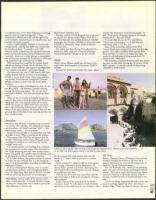
Clockwise from top left: Mud bathing at the Dead Sea; entrance to the Church of the Holy Sepulchre
in the Old City of Jerusalem; sailing in the Red Sea near Eilat.
for three hours with Arab citizens irate over the
deaths of 12 Israeli Arabs in protests in northern
Israel.
Haifa, proud of its relations with its Arab minori-
ty, is trying to become a tourist destination. It's
famous Baha'i gardens and shrine, dominating the
Mt. Carmel slope overlooking the city, will celebrate
its completion next May.
The city has three Arab city councilmen and the
city comptroller is Arab, as are 22 percent of munic-
ipal employees.
Mayor Mitzna made a strong pitch for Jewish
tourism to Israel. "It is the densest locale of Jewish
attractions in the world and you can connect to this
Tel Aviv
Former Detroiter Sherry (Domstein) Fox and her
husband Michael have been in Tel Aviv for a
month. Michael is on a six-month assignment in
Israel for Norte! Communications.
The two Bethesda, Md., residents are polishing
their two years of University of Michigan Hebrew
classes – Michael at work and Sherry in an ulpan
(intensive Hebrew work-study center). They're
having a wonderful time in Israel and find it very
safe.
"There are things happening 30 miles away, but
there is nothing happening here," said Sherry.
Added Mike, "There are areas of Detroit that you
d
12/22
2000
27