

Com mun ity
Spirituality
A Bittersweet
' g
llomecomin
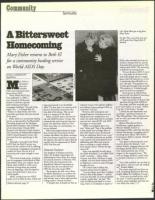
Lefi-• Sylvia Block gets a hug from
Mary Fisher.
Far left: This is one of the two new
AIDS quilts that Temple Beth El
donated
Sta ff p ho tos by Krim Husa
Mary Fisher returns to Beth El
for a community healing service
on World AIDS Day.
DIANA LIEBERMAN
Staff Writer
M
ary Fisher is
devastated
when she
considers
what most Americans don't
know about AIDS.
When World AIDS Day
was established in 1988, it
was "saluted by Hollywood
starlets in television specials
and screaming warnings in
newspaper headlines," she said Friday
night, Dec. 1, at Temple Beth El.
"Today it is observed by a few who
remember and those who have learned
to be quiet."
Fisher spoke at a community healing
service co-sponsored by the Bloomfield
Township temple and the Michigan
Jewish AIDS Coalition. She is founder
of the Mary Fisher Clinical AIDS
Research and Education Fund, based at
the University of Alabama/Birmingham's
AIDS Clinical Research Center. Any
proceeds from her speeches go to the
center.
Although it coincided with World
AIDS Day, the Beth El service was
meant for the comfort of all in suffering
or mourning. Congregants and guests lit
candles for those who are ill or in
mourning and to give strength to care-
givers.
They heard several poems, including
one by congregant Sylvia Block of West
Bloomfield, whose son, Nathan David
Block, died of AIDS in 1996, and a
selection of songs from the musical
From the Beginning I Did Not Speak in
Secret, first performed in June as an
AIDS benefit.
MJAC unveiled two new AIDS
quilts, sewn by Beth El teens, which will
Related editorial: page 37
hang permanently in its Southfield
office. The first quilt is in memory of all
those in the Jewish community who
have died of the disease. The second
quilt is in memory of Mr. Block.
Fisher, a Detroit native, has been liv-
ing with AIDS for about 10 years. She
contracted the virus from her then hus-
band, who died from AIDS in 1993.
Their sons, Max, 13, and Zachary, 11,
are not infected.
Fisher had stopped taking the drugs
that control the virus because of their
virulent side effects. But lately, warnings
from her doctors caused her to resume
the regimen. She said her talk at Beth El
was her only live appearance for World
AIDS Day this year.
National Disclosure
The daughter of Marjorie and Max
Fisher, the Franklin industrialist and
philanthropist, Mary Fisher first attract-
ed national attention in February 1992.
That's when she announced at the
Republican National Convention in
Houston that she was infected with
HIV, the virus that causes AIDS.
Her purpose, she said, was to force
her fellow Republicans to confront the
disease, and to realize that compassion
and activism were a better response than
hiding under a "shroud of silence."
"I thought that, if people saw that an
ordinary woman with ordinary children
and ordinary hopes could get AIDS, so
could they," she said.
However, after initial panic and
changed behavior, Americans are now
sliding back into complacency. As a
result, the steady drop both in mortality
rates and new cases of HIV and AIDS
has begun to reverse itself
"AIDS is an epidemic that is not
over," Fisher said. "Part of the problem
is that people want to forget about it;
they think there's a cure. Just because
there are medicines, there is not a cure."
The available treatments are prohibi-
tively expensive for most patients, have
debilitating side effects and must be
taken according to a rigid schedule.
Some people cannot tolerate the regi-
men at all.
Fisher was especially forceful about
the AIDS devastation in so-called "third
world" countries — Africa, India,
Vietnam and others. Medicine is rarely
available, and even those without AIDS
are fighting to survive in areas of hunger,
drought and war.
On a recent visit to Africa, she
reported seeing "acres of orphans."
"Last year alone, more than 2 million
Africans died of the disease — and for
every one that died, 12 more are headed
toward a similar fate," she said. "The
scale of suffering and death is so stun-
ning, I have no vocabulary to report it."
Fisher, who attended and was con-
firmed at Temple Beth El, said she
frequently feels stereotyped as "that
woman with AIDS." But returning
to Beth El was coming home.
"It's not all about AIDS. It never
is — not really. It's all about God
and God's people, about a congre-
gation that will welcome us, or not;
a community that will hold us, or
not," she said. "The question isn't,
`Is there grief enough to go around?'
The question is, 'Is there enough
grace to hold one another?'"
Participants in the healing
service left the Beth El sanctuary
somber but invigorated.
Gary Grossman of Royal Oak
has been living with AIDS for
five years, and has received sup-
port from Fisher via e-mail. "When
I see her, I feel hope," he said.
"I think she was absolutely out-
standing," said Rose Freeman of
West Bloomfield. "She expresses her-
self so well, and what she said was
phenomenal."
Melissa Moroff and Erica
Needleman, eighth-graders at
Warner Middle School in
Farmington Hills, said they felt their
school was doing a complete job of
teaching them about HIV/AIDS.
Listening to Fisher's speech, Moroff
said, "I cried."
"Our goal is educating the com-
munity about the disease," said
Arlene Sorkin, program director for
Michigan Jewish AIDS Coalition,
who substituted for one of the
singers in the musical revue. "We
were so happy [Fisher] could come,
so people could put a real face on
it.
"Our only problem was we had to
sing after it, and we were all choked
up," Sorkin added.
The event attracted non-Jews as
well, including Rosemarie Rowney,
health officer for Oakland County.
"I was very touched by her talk,"
she said. "I realize people have a
need to come together, and this ser-
vice filled that need." ❑
12/
20(
51