

Although mixed marriages were not common at that
time, Carter writes in his biography, "the Weils accept-
ed such a union for their daughter more readily because
they did not observe the Sabbath or keep a kosher
house. They went to temple only on major religious
days, such as Yom Kippur." They also followed Jewish
burial and mourning customs.
Proust himself, born in 1871, seems not to have stud-
ied or been particularly interested in Judaism, says
Carter. But his mother's and her family's influence on
his development was incalculable.
"Proust loved his mother and grandmother more
than anyone and for the first 20 or so years of his life he
spent much more time with his mother's family than
with his father's," Carter says. "There is no question
that he knew his mother's relatives and was much closer
to them than his father's.
"Proust's education in terms of music, literature,
painting and languages and his taste in many matters
were heavily influenced by his mother and his maternal
grandmother," says Carter. "In [Remembrance of Things
Pact], the mother and grandmother are based on them."
Many of Proust's friends throughout his life also were
Jewish. So is Charles Swann, a major and heroic charac-
ter who figures throughout Remembrance.
Proust And French Anti-Semitism
Throughout his work, Proust probed deeply into the
subject of French anti-Semitism, particularly as it
played out during the Dreyfus Affair.
Though he is better known for his knowledge of the
social whirl than for his political consciousness, Proust
took an active public role in support of Captain Alfred
Dreyfus, the Jewish army officer falsely accused, con-
victed and imprisoned for treason — and whose inno-
cence was ultimately proven.
"Proust sought to secure the names of prestigious
writers and composers for the petition for a retrial and
exoneration of Dreyfus," says Carter. "He did secure the
name of Anatole France, a truly distinguished and
respected writer who was a member of the Academie
francaise. He also attended one or perhaps a few sessions
of the Zola trial and took notes for the novel Jean
Santeuil that he was writing at the time.
"Proust was convinced that Dreyfus was innocent and
had been wrongly condemned simply because he was
Jewish," Carter continues. But Proust's sense of justice
was such, Carter believes, that he would have responded
in a similar way had Dreyfus not been Jewish.
Thus, Carter concludes, "the way Proust behaved
during the Dreyfus Affair had little to do with his
Jewish heritage."
Nonetheless, Carter points out, "whenever anyone
made remarks in front of Proust that he considered
anti-Semitic, he protested and reminded [the individ-
ual] that his mother was Jewish."
Child Of Intermarriage
Interestingly, essayist Barbara Probst Solomon has woven
out of these same facts an intriguing interpretation of
Proust's life and work — basically, that the psychological
engine that drove him was his parents' intermarriage.
In Solomon's view, as the baptized son of a Catholic
father and of a Jewish mother who did not convert,
Proust felt torn between the two religions, and the two
sides of his family.
"Proust the child was profoundly alarmed that his
mother's religion was different from his," she specu-
lates. This contributed to what Solomon calls a sense
of identity confusion, a questioning of "Who am I?"
that runs throughout Proust's work.
Unlike today, Solomon points out, in Proust's day
"there was no pop-Judaism, no Hollywood Yiddish
slang, no smorgasbord varieties of assuming" a Jewish
cultural identity.
"One was Jewish through adherence to the Jewish
God. You were either Orthodox or lapsed Orthodox."
But Proust himself was neither.
Part of his quest, then, became forging a path toward
a secular Jewish identity — a way that would allow him
to remain close to his father, with whom he shared
the Catholic religion, as well as to his Jewish mother.
That pathway was the Dreyfus Affair, says Solomon.
In speaking out against anti-Semitism and injustice,
Proust was able to be true to his mother, without
abandoning his father. And by convincing his father,
an eminent physician, to lobby for an investigation
into Dreyfus' deteriorating health, Proust brought
both religious sides of the family together, in a unified
cause. More important, Proust was able to see himself
as unified, no longer divided.
Because Proust disliked labels, he did not wish to be
tagged as Jewish, homosexual or even French, Solomon
says. But through his actions, she continues — tongue-
in-cheek — Proust became "even better than a Jewish
son — he was the numero uno Dr9fusard."
Still, as true as this view may ring at a time when so
many interfaith families are struggling to find a path
for themselves, this is only one interpretation of Proust.
When asked his views of Solomon's thesis, Proust
biographer Carter commented that he had not read
the article. He did agree that "it's true that the Dreyfus
Affair made Jews aware that they were Jews, whereas
many had thought of themselves as French first and
Jewish second."
But he does not believe Proust felt torn as the child
of intermarriage. "Proust did not feel torn because his
parents genuinely loved each other and seemed to be in
complete agreement as to how Marcel and his brother
Robert should be raised and educated," he says.
"Proust's father, Adrien, was as close to and affec-
tionate toward his wife's family as was Marcel. Since
his parents treated each other with such respect and
devotion, and since Dr. Proust spent all those summer
months at the Weil estate in Auteuil and always wel-
z
u
comed the Weils to his home, I don't think it would
ever have occurred to Marcel that there was anything
, 3
to be torn about.
O
Influence On Writers
Maybe yes, maybe no. But what cannot be argued is
that, despite a general lack of consciousness of Proust's
links to Judaism, several well-known contemporary
Jewish writers have paid homage to Proust's influence
on them.
Israeli novelist and Holocaust survivor Aharon
Appelfeld, author of such acclaimed works as
Badenheim 1939 and The Retreat, described his affinity
for Proust's work, calling himself, as well as the French
novelist, "an assimilated Jew."
"My work is also similar to Proust," he told an inter-
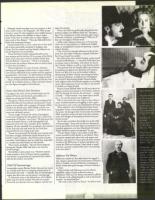
Top to bottom:
Marcello Mazzare
as The Narrator a
Catherine Deneuv
as Odette de Crecy
1 scene from "Tim
runnii
th - weekend at th
Det -oit Fllfn The
Prows on his
deathb ,'d,
ph. otogwphed
by Man Ray,
Nov. 22, 1922.
Prousts Jewish
mother; flee Jeann
Weil, with her 501
Marcel, left, and
Robert, 1893.
Charles Haas, 18
lt ,as the principal
modelfb r Charles
Swann, a major
and heroic Jewish
character wholip
throughout Proust
"Remembrance of
Things PEW. " Hai
,
rtymen aristocra
associated with th
court of Napoleon
was the only Jewi,
member of the
ex.-elusive /oc kty C