

DIANE COLE
Special to the Jewish News
IV
hat would you say if I told you that the memory-
inducing pastry French novelist Marcel Proust
dipped into his tea wasn't really a petite madeleine
but a kosher eugelach?
OK. You're right. I'm kidding.
But this fantasy is not as farfetched as it sounds — especially
when you consider that Proust was one of the great Jewish writ-
ers of the 20th century.
And this time I'm only half-kidding.
So enduringly resonant does this author who straddled the
19th and 20th centuries remain at the turn of the 21st century
that, in recent months, American publishers have released three
new Proust biographies.
Just weeks ago, a literary all-star cast gathered at New York's
Lincoln Center to celebrate the author of the monumental
seven-volume novel Remembrance of Things Past (or, in the origi-
nal French, A la recherche du temps perdu). The evening-long
tribute, "Proust Recaptured," was sponsored by the PEN
American Center.
In addition, a new movie drawn from the final volume
of Proust's masterpiece, Time Regained, has garnered favor-
able reviews at the Cannes, New York and Telluride film
festivals. Directed by Paul Ruiz, who co-wrote the screen-
play with Gilles Taurand, the film stars Catherine
Deneuve, Emmanuelle Bean and John Malkovich, and
opens at the Detroit Film Theatre this weekend.
The Jewish Connection
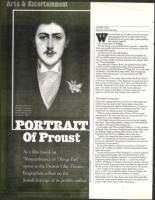
Portrait of Marcel
Proust as a young
socialite by Jacques-
Emile Blanche, oil
. On canvas, 1893.
As a film base
Remembrance of Things Past"
opens at the Detroit Film Theatre,
biographers reflect on the
Jewish heritage of its prolific author.
Despite the ongoing fascination with Proust, surprisingly little
attention has been paid to the Proust-Judaism connection,
asserts author and critic Barbara Probst Solomon, in a provoca-
tive essay tided "Citizen Proust: On Politics And Race," pub-
lished in her new literary journal, The Reading Room.
"With so many tomes devoted to Proust, and to so many
other themes in his work, how does one account for that?" she
wondered in a recent telephone interview.
As if to bring this point home, not once during the lengthy,
three-hour "Proust Remembered" celebration in New York did
the subject of Proust's Jewish heritage arise.
Is this neglect real? Proust scholar William C. Carter, professor
of French at the University of Alabama and author of the recent-
ly published, highly acclaimed Marcel Proust: A Life (Yale
University Press; $35) has a different take on the issue.
"I think a fair amount has been written, but mostly in
French," he responded in an interview conducted via e-mail.
Even so, he continued, "the paucity of documentation accounts
for the lack of more studies."
In fact, both Solomon and Carter are correct, as the facts of
Proust's life so deftly chronicled in Carter's comprehensive biog-
raphy demonstrate.
Proust's mother, Jeanne Weil, belonged to a cultured, political-
ly powerful and financially well-to-do Jewish family in Paris.
Jeanne Weirs uncle Adolphe Cremieux was one of the leading
progressive political figures of his day — a man who champi-
oned the abolishment of slavery in the French colonies, and who
was instrumental in gaining French citizenship for Algerian Jews.
He also was one of the leaders of the French Jewish community.
Out of respect to her parents, Jeanne declined to convert
when, in 1870, she married Dr. Adrien Proust, a Catholic. She
did, however, agree to raise their children as Catholics.
Diane Cole, based in New York, writes about books and other
subjects for many national publications and is the author of the
memoir "After Great Pain: A New Life Emerges."