

This Week
SHELLI LIEBMAN DORFMAN
w
Staff Writer
hen Synagogue 2000
came to town this sum-
mer, the 4-year-old proj-
ect was met with open
arms.
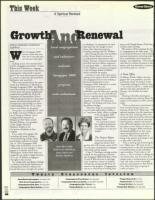
Looking to join the national initia-
tive for synagogue spirituality, 11 local
Reform and Conservative congrega-
tions and one Conservative Ann Arbor
congregation volunteered to partici-
pate in the cross-denominational proj-
ect aimed at achieving self-assessment,
facilitation and teamwork.
"We're very excited about the oppor-
tunity that Federation is affording us
through Synagogue 2000," says Rabbi
Arnie Sleutelberg of Congregation Shir
Tikvah about the project significantly
underwritten, locally, by the Jewish
Federation of Metropolitan Detroit.
"We're looking forward to a three-year
process of renewal and growth and
introspection and coming to a better
understanding of who we are, where
we're at and where we are going."
The project was established in 1996
by Rabbi Lawrence Hoffman, profes-
sor of liturgy at Hebrew Union
College-Jewish Institute of
Religion in New York, and Dr.
Ronald Wolfson, vice president
of the Ziegler School of
Rabbinic Studies at the
University of Judaism in Los
Angeles.
It is a study of synagogue life,
including the areas of prayer,
institutionalizing change, study,
good deeds, ambiance and heal-
ing. In 1996, Synagogue 2000
began with involvement in 16 cities
nationwide. It now includes 11 syna-
gogues in Colorado and five in
Washington. Various New York con-
gregations are ready to begin the proj-
ect as are 18 Reform synagogues
throughout the country.
Dr. Lynda Giles and Robert Naftaly,
co-chairs of the Jewish Federation of
Metropolitan Detroit's Alliance for
Jewish Education, brought the project
A Spiritual Renewal
to Michigan. In preparation for their
AJE roles, the two sought to learn
about other education projects,
including meeting with Dr. Wolfson.
After sharing the idea with members
of the Detroit Jewish community —
including Penny Blumenstein and
Robert Aronson, Federation's president
and chief executive officer, respective-
ly; and local rabbis — they then invit-
ed Dr. Wolfson to present his program
to the Michigan Board of Rabbis,
which endorsed the project.
Contrary to most other cities partic-
ipating in the project thus far, individ-
ual synagogues here are not making a
financial contribution to join
Synagogue 2000. Federation is under-
writing much of the cost.
"Federation is paying around
$100,000 a year for three years, paying
for much of the cost of a kick-off con-
ference, ongoing study, team meetings
and two seminars," says Harlene
Appelman, director of Federation's
Alliance. The funding will come from
the Alliance budget
"They have made an investment for
us, and made staff people available to
us," says James Safran, officer-in-charge
of the Synagogue 2000
team from Congregation
Shaarey Zedek.
An anonymous donor
has supplied funding for
Ann Arbor's Beth Israel
Congregation to also par-
ticipate.
.
The Project Begins
Each participating syna-
gogue has chosen chair-
persons who will oversee a team of 20-
25 volunteers comprised of synagogue
staff, clergy and lay leaders.
A Sept. 17 facilitator-training seminar
marked the first gathering of Detroit-
area Synagogue 2000 leadership. A Nov.
19 and 20 kick-off event at the Eagle
Crest Conference Center in Ypsilanti
will host the anticipated 400 local vol-
unteers in the program. Congregations
now are in the process of making their
teams, with Temple Emanu-El the first
to hold a team meeting.
The project will be ongoing for the
12 congregations, for three years. "We
are starring the first year with building
spiritual community; including ambit
ence, membership and institutional
change," says Appelman. "The second
year, there is a choice of prayer or edu-
cation, with the third year a continua-
tion of that path or a switch."
A Team Effort
At Shaarey Zedek, Safran, the syna-
gogue's first vice president, says the
excitement about the project is that
"practically nothing is etched in stone
— it's etched in Jell-O — really mold-
able for each shul. Specifically for
Detroit, a lot of effort has taken
place."
Meeting with other participants,
team members have learned about the
impact of the project in other commu
nities.
"This is a three-year commitment t
form a bond among various con-
stituents of the shul," Safran says. "W
selected members who feel passionate
about the shul, including those who
are more observant and less observant,
involved and not involved, some day-
school parents, a good cross-section,
who will bond together, step back and
say where we are, where we want to
be. The Synagogue 2000 curriculum
developed guidelines on how to go
about being facilitators and team
members. We have asked them to
bring in lay persons and clergy to tell
us how other cities did it.
"This is moving and motivating for
me," Safran says. "We want to see a '1
transformation in the shul and person-,
al transformation in the individual
team members. That's what it's all
about — then it's easier to change the
rest of the team, too. If a team of 25
people make a transformation of some
type and make a more meaningful
personal commitment to their family
lives, their shul, they are going to
make an impact." [1]
CO CITES
Congregation B'nai Moshe, West Bloomfield
Beth Israel Congregation, Ann Arbor
Congregation Shaarey Zedek, Southfield/Wiest Bloomfield
Congregation Shir Tikvah, Troy
Temple Kol Ami, West Bloomfield
Temple Beth El, Bloomfield Township
Temple Shir Shalom, West Bloom field
Congregation Beth Ahm, West Bloomfield
Congregation Beth Shalom, Oak Park
912S
2000
64
Temple Emanu-El, Oak Park
Temple Israel, West Bloomfield
Mat Shalom Synagogue, Farmington Hills