

Health
RUTHAN BRODSKY
Special to the Jewish News
D
enise Levenson of Oak
Park hasn't forgotten the
anguish, fear and
despair of that evening
five years ago.
It was a Dream Cruise weekend
in August when she and husband
Arthur ended up at the hospital
emergency room with their 9-year-
old son Daniel.
"He was asthmatic and we
thought he was coming down with
a bad case of the flu," recalls
Levenson. "That evening his condi-
tion worsened, and we couldn't
bring down his temperature or help
his breathing. As he slipped into a
coma, we learned Daniel was dia-
betic."
Neither the Levenson family, of
Oak Park, nor their pediatrician
knew that Daniel was diabetic.
There were none of the usual signs
in his life or in his annual medical
examinations.
"We were in shock and it got
worse. We were told that the odds
of him coming out of this comma
were not very good. The entire
family gathered; friends and neigh-
bors joined together," Denise
Levenson said. "With lots of help
and lots of prayer, Daniel emerged
from his coma five days later. It
was a miracle."
Even so, all was not well. Daniel
awoke with excruciating pain in his
right leg; he couldn't walk. He
missed school for four months
while physicians tried to resolve the
damage that was caused by nerve
blockage.
Diabetes is a chronic disease. In
a child with type 1 (insulin-depen-
dent) diabetes, the pancreas does
not produce insulin and the sugar
in the blood can't be used. The
sugar builds up in the bloodstream
even when the body is starved for
energy.
A person with type I diabetes
must take daily injections of
insulin to stay alive.
The Levensons admit to making
complete pests of themselves, ask-
ing questions, seeking help —
vnatti,:ktgiee
9/8
2000
00
whatever they could do to get their
son back on his feet. After several
months, a specialist performed a
neurological procedure. After six
months of physical therapy, Daniel
regained almost full usage of his
leg. School was a mix of home
schooling and attending classes
when possible.
For the next several months, the
family, including 11-year-old sister
Molly and 20-year-old sister Stacy,
accommodated their lives to
Daniel's insulin schedule: four
injections a day.
"Less than a year from the first
trauma, I noticed that there were
bruises covering Daniel's body,"
says Denise Levenson. The doctors
diagnosed a bleeding disorder
(ITP) resulting from a shortage of
platelets, with characteristic bleed-
ing under the skin. As a result,
every eight days, Daniel was admit-
ted to the hospital for four days.
He received an intravenous infu-
sion of gamma globulin to increase
the platelet count.
The ITP precluded the physical
activity that Daniel was to use to
better manage his insulin. Exercise,
food and insulin are the three vari-
ables of diabetes control.
"We were told he would get bet-
ter soon but our stays at the hospi-
tal went on for 2 1/2 years. We took
turns staying with Daniel at the
hospital. My husband lost his job.
What made it worse was that
Daniel wasn't getting better,"
Denise Levenson says.
"We went to the National
Jewish Hospital in Denver and
spoke with an immunologist and
hematologist. We questioned, we
cajoled. We made pests of ourselves
again and ended up at the
University of Michigan Hospital in
An Arbor, working with a pediatric
hematologist who received his
training in Denver.
"I even consulted a naturopath,
who recommended supplements
for Daniel. He ended up taking 14
supplements a day, but they were
helping to keep him out of the
hospital. His physician kept saying,
`Whatever you're doing, keep doing
it.'"
T J
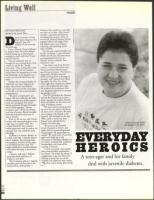
Daniel Levenson battles
his disease on two fronts.
E11111.11.1T
liEROICS
A teen-ager and his family
deal with juvenile diabetes.
:\N\
.
Z S ZIKSS M M ,.;:
X,X‘V',‘
M WM \s
\NMI