
to wonder exactly what "literacy" meant.
She concluded that much more than being
able to read, it's also "the ability to orally
communicate your thoughts, to listen and
understand," she says.
Davis further began to consider ways to
improve her teaching methods. "I thought
about what we were doing in terms of
direction," she says. "I saw that we might
actually be doing students a disservice,
automatically sending them to college after
high school when that is not necessarily the
answer for all students."
Even the brightest of students may not be
certain about what to do with his or her life,
she says, adding that it should not be
assumed "that schools will give students
career direction."
Davis points to a survey of 7,000 adoles-
cents done by Dr. Barbara Schneider, a pro-
fessor at the University of Chicago, and the
late David Stevenson of the federal Office of
Science and Technology Policy. The survey,
"The Ambitious Generation: America's
Teenagers, Motivated but Directionless," con-
cludes that most young women and men have lit-
tle understanding of what is needed for success
on the job.
Following her open-heart surgery, Davis chose
to commit herself to a project that would
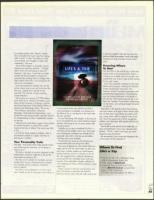
improve the lives of others. The result was Life's
a Trip.
As with her book aimed at children, Life's a
Trip teaches students to "apply what they're
learning to a context."
Your Personality Traits
She asks, "And doesn't that make sense? If what
you're learning has meaning, you're going to
want to do it."
The book is divided into sections designed to help
students learn what they might like to do and the
practicalities of getting to do it.
She asks you to consider, for example, your per-
sonality traits: Are you charming and/or competi-
tive; articulate and/or analytical; methodical
and/or patient?
And what is your preference in a work environ-
ment. Would you like to wear jeans to the office, or
is work as a graphic artist. (Surveys show the
profound effect that parents, friends and neigh-
borhood can have on career choices, Davis
says.)
Knowing Where
To Start
Not that Life's a Trip will tell you, at the end,
exactly what to do professionally. Rather, it
is a suit and tie more your style? Do you like to
work according to a schedule, or is coming in to
the office at 9 a.m. one day but a few hours later
the next, just fine?
Do you like being with people, or do you pre-
fer to be alone? Do you crave hands-on respon-
sibilities, like fixing a car, or enjoy purely intel-
lectual pursuits?
Probably you've never considered all of this —
and that's just the problem, Davis says. The experi-
ence of doing the workbook can actually be fun,
especially when Life's a Trip has you ask others
what they see as your strengths.
The answers you come up with will point you
toward certain jobs and away from others.
Once you've figured out which career paths you
might want to look into, Davis helps you plan your
next move: consider whether you should pursue
technical training, enroll in a university, or do nei-
ther. She suggests how to make the job-interview
process (painful as it invariably is) go a bit more
smoothly. Davis also offers a lengthy collection of
Web addresseS for those wanting information about
student aid.
There's a section in the book aimed at Mom and
Dad, who always wanted their little Rachel to
become a lawyer when what she really wants to do
will give you a better sense of yourself, your
capabilities and where to get started looking
for the right career.
Davis has presented workshops on this topic
before various groups, including the National
Career Development Association, the
American School Counseling Association and
parent-teacher organizations. One thing she
says she always advocates is the beauty of
job diversity. Why should everyone go to col-
lege? she wonders. If your dream is becoming
an electrician, why not head straight for techni-
cal school?
Regardless of the desired career, Davis advises
men and women of all ages to learn the four skills
that will help them to get ahead anywhere: read-
ing, writing, basic math (no need to worry if you
don't know the square root of 450; just get that
addition and subtraction stuff straight) and how to
use a computer.
She herself recently picked up the latter skill, no
easy accomplishment, Davis says, because she's
dyslexic. "At first I couldn't even type, so I never
imagined using the Internet."
But persevering, Davis wrote and designed Life's
a Trip entirely on the computer. 0
Where To Find
Life's a Trip
• Purchase locally at the Self-Esteem Shop,
32839 Woodward, Royal Oak
• Order online at amazon.com
• Contact Jill Davis at (248) 642-7582;
e-mail, iffidavis@wwnet.net , or send $40
check to Yale Publications,
P.O. Box 183, Birmingham, MI 48012
9/1
2000
93
Scanned image of the page. Keyboard directions: use + to zoom in, - to zoom out, arrow keys to pan inside the viewer.
September 01, 2000 - Image 121
- Resource type:
- Text
- Publication:
- The Detroit Jewish News, 2000-09-01
Disclaimer: Computer generated plain text may have errors. Read more about this.