

"[Anni] belonged to a stratum of German
Jewish culture where, although people knew that
they were Jewish, they practiced Protestantism,"
explains Nicholas Fox Weber, executive director of
the Josef and Anni Albers Foundation and an
exhibit curator working with Pandora Tabatabai
Asbaghi, former director of the Prada Foundation.
"This may sound inconsistent to many people
today, but they knew they were Jewish because of
their names (the artist's being Annelise
Fleischmann) and their family ties. She never
practiced any religion, although she and Josef were
married in the Catholic Church because he was
rather devout.
"She had no experience with organized
Judaism as a child, but once she learned about it,
she tried to develop materials appropriate to those
•
purposes."
Organized by the Josef and Anni Albers
Foundation and the Peggy Guggenheim
Collection, Venice, The Jewish Museum exhibit
features 25 of the artist's unique wall hangings and
pictorial weavings, a broad range of her drapery
and upholstery fabrics, wall coverings, fabric
swatches, texture studies, room dividers, jewelry,
prints and drawings.
Personal items — letters, photographs, docu-
ments and examples from her collection of pre-
York's Museum of Modern Art in 1949.
Josef and Anni Albers came to the United
States in 1933 under the sponsorship of Edward
M. M. Warburg and the Warburg Mansion, now
the home of The Jewish Museum. The Alberses
lived at the mansion before moving on to North
Carolina, where they found refuge at the experi-
mental Black Mountain College, and then
Connecticut, where she died in 1994.
"I consider Anni Albers a woman very much
ahead of her time, but I'm not sure that anyone's
exhibit installation to enable viewers to under-
stand the separateness and the connectedness of
the different aspects of her art and to have a sense
of her life as well.
"She never showed any of her work in her
home," Weber says. "She had almost a perverse
need to keep it behind closet doors, but there is one
weaving called Open Letter, which she kept and did
not sell or let go to a museum because she consid-
ered it her personal communication to Josef."
The first section of the exhibit is devoted to
Albers' years at the
Bauhaus with wall
Josef and Anni
hangings and
Albers in Anni's
gouaches, which are
workshop in
intended to be
New Haven,
viewed
along the
Conn., circa
walls
in
the same
1955. Josef
way as paintings, and
was a teacher
practical materials
at Yale.
displayed on tables.
The following sections continue the
display pattern with singular works of
art, weavings and works on paper.
There are samples of the jewelry assem-
bled out of hardware components and
everyday objects in the 1940s.
The benches in the exhibition
The Jewish Museum celebrates
the centennial of a pioneering textile artist.
Columbian textiles — also are on view.
Born in 1899 Berlin, Albers gave up the luxu-
ries of a comfortable bourgeois childhood for the
rigors of the Bauhaus School in Weimar in 1922.
There, she studied with Paul Klee and began
weaving meant to stand on its own as abstract
works of art comparable in their boldness and
modernism to some of the strongest paintings of
her era.
Albers' weavings showed an ability to organize
complex combinations of materials and gave no
sign of a genetic physical problem that prevented
her work with heavier media. She was the first tex-
tile artist celebrated with a solo exhibition at New
caught up to her," says Weber, who began working
for the foundation when the artist was still living.
"It's not as if there are lots of women now doing
what she did then. She was apart from her time,
more independent, smarter and unique.
"She had a continuous passion for simplicity,
and her style evolved initially in reaction to the
world in which she grew up. She reacted against
the highly decorative style of her childhood, going
from a rather extreme and severe stance of the
Bauhaus period to a somewhat looser, more
relaxed and more comfortable approach in
America."
Italian architect Gae Aulenti has designed the
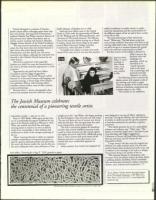
Anni Albers: "Drawing for a Rug 11",” 1959, gouache on paper.
were designed to use one of Albers' upholstery
materials. During her lifetime, she wove function-
al textiles in small amounts for specific purposes
or had them produced, by machine, in greater
quantities.
"The exhibit presents the art in a particularly
coherent and cohesive way," Weber says. "The
[space] is somewhat larger than it has been in pre-
vious showings (the Peggy Guggenheim
Collection in Venice, the Josef Albers Museum in
Bottrop, Germany, and the Musee des Art
Decoratifs in Paris).
"I hope viewers will take away the magical pos-
sibilities of a really inventive artist. I'm not inter-
ested in lessons about husband and wife or her role
in relation to her marriage or her role as a refugee.
The primary thing is the quality of the art.
"The common element is a fascination with
structure. From the earliest work to the latest, there's
a unifying aesthetic sensibility. There's somebody
who was extremely interested in balance, harmony,
rhythm, calm, liveliness and juxtaposition." ❑
"Anni Albers" will be shown through August
20 at The Jewish Museum, 1109 Fifth Ave.,
New York. (212) 423-3271. www.thejewish-
museum. o rg.
,,The Josef and Anni Albers Foundation, Bethany, Conn. Photo by Tim Nightswander
7/2
200
75