

• AC
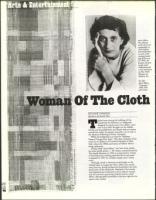
Anni Albers:
Her abstract
works of art are
comparable in
their boldness
and modernism
to some of the
strongest paint-
ings of her era.
In 1949, she
became the first
textile artist
celebrated with
a solo exhibition
at New York's
Museum of
Modern Art.
Far left:
Anni Albers:
"Ci sca e,"
1949, bast
and cotton.
f The Cloth
SUZANNE CHESSLER
Special to the Jewish News
:
. ,,4 , 40044****045we,,•,
••
O
0
0
O
7/21
2000
74
ucked away among the holdings of the
Cranbrook Art Museum is a bedspread
designed by textile artist Anni Albers, a pio-
neer in her field. Brought out for display
during weaving exhibitions and shared with art centers
around the world, the spread currently is on its way to
the Museum Folkwang in Essen, Germany.
While the bedspread is on loan for "Bauhaus:
Dessau-Chicago-New York," 200 other examples of her
work are on display at The Jewish Museum in New
York, where the 100th anniversary of Albers' birth is
being celebrated.
Simply titled "Anni Albers," the New York exhibit
has some Jewish pieces — Six Prayers, commissioned by
The Jewish Museum in 1965 as a memorial to victims
of the Holocaust; working materials for an ark panel
completed in 1957 for a Dallas temple; and a matza
cover.
Although raised in Germany and brought to the
United States to escape the Nazis, Albers was turned
away from her Jewish background long before the early
persecution of the Holocaust. Members of her family
were baptized and confirmed in the Lutheran church,
and she married a practicing Catholic painter, Josef
Albers, distinguished artistically in his own right for his
square color studies.