

Spirituality
SHELLI LIEBMAN DORFMAN
StaffWriter
T
he offer of a glimpse into the
future of their profession
brought a standing-room-
only crowd of 300 cantors
for Dr. Ron Wolfson's research-based
prophesies.
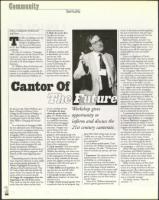
His May 23 workshop, "Synagogue
2000: Implications for the Future of the
Cantorate," was part of the five-day
53rd annual Cantors Assembly conven-
tion held at the Hyatt Regency Hotel in
Dearborn.
Dr. Wolfson, dean of education and
vice president of the University of
Judaism in Los Angeles, concluded the
seminar as a complement to a workshop
held by Rabbi Lawrence Hoffman on
enlists and connects.
9: Make the service flow.
He refers to the term
"tefillas-interruptus" as a
break in the mood and
rhythm of the service. He
says the cantors have been
saying this for years, and it
is true.
8: Bring an emotion arch
to the service. As a consul-
tant for the 1998
Dreamworks' film The
Prince of Egypt, he describes
a story board listing the
emotional tone of the
movie, from the high energy
of the chariot race to the
scenes of lesser activity. He
says this can be incorporat-
Cantor Of
the previous day. Rabbi Hoffman, pro-
fessor of liturgy at Hebrew Union
College-Jewish Institute of Religion in
New York, spoke on the subject of
"Looking for God in the Year 2000:
Why Tefilla is Changing All Around
Us."
As co-founders of Synagogue 2000,
the two addressed issues of developing
the 21st-century synagogue based on an
ongoing seven-year research study.
Synagogue 2000 is a national institute
established for the spiritual transforma-
tion of synagogue structure and culture.
The project combines a vision of the
Jewish future and synagogue life with
change-management techniques.
Dozens of congregations nationwide are
participating in various programs, with
Detroit on the roster beginning next
year.
Determining music to be one of the
more important elements in what uplifts
and energizes people spiritually, Dr.
_Wolfson highlighted his seminar by
offering a David Letterman-style "Top
10" look at what will most benefit the
cantor of the 21st century. He says the
cantor of the 21st century should:
10: Engage the congregation from the
beginning to the end of the service.
They need not sing the whole time, but
music from the cantor and the choir
6/2
2000
84
Workshop gives
opportunity to
inform and discuss the
21st century cantorate.
eel into worship services.
7: Consider the space
where the service takes
place. Dr. Wolfson looks at
the synagogue of the past
as a model for the future,
with the bima (synagogue
dais) in the center of the
sanctuary. "Imagine your
power, being in the mid-
dle, as one with the con-
gregation, davening [praying] with
them,” he says, opposing what he terms
the "battle of the bima" with the rabbi
and cantor taking turns standing in
front of the congregation.
6: Teach repertoire. With the example
of folksinger Debbie Friedman, Dr.
Wolfson sees teaching new tunes, even
during the service, as a way to connect
to the congregation. He feels you can't
have too many melodies for the same
prayer and suggests turning the car into
a classroom with CDs and tapes of
music from the service.
5: Make skillful use of repetition. He
uses the slow rise and fall within
Chasidic music as an example.
4: Get people to learn to be ba'al
tefillas (prayer leaders). Let them help
lead the service.
3: Make a broad musical agenda. With
a prediction that the old program Sing
•
Along With Mitch will be back, he says,
"People want to sing. The choir can
teach them. Spread them throughout
the congregation."
2. Get a serious sound system. These
words from Dr. Wolfson brought imme-
diate applause. He adds, "The back row,
where everybody sits anyway, can't hear
you."
1. Experiment. He stresses the need for
experimenting with a family service, a
tot-Shabbat or a youth program.
Cantors should meet with lay leaders
and rabbis, promoting themselves as the
ones to help shape musical traditions.
He says the position of the cantor needs
to be elevated: "We have to change the
false perception of allowing the congre-
gation to believe you are there only to
pray for them."
Most of Dr. Wolfson's educated pre-
dictions gained agreement from the
crowd. A discussion ensued regarding
the lack of attendance and participa-
tion in worship services and how the
cantor can help make changes.
Rabbi Joel Myers, executive vice
president of the Rabbinical Assembly
in New York, suggests the answer is in
the shorter, Friday night service. "It is
the place to see all the creativity and
singing different tunes and tefillot
[prayers]."
Cantor Ira Bigeleisen of North
Hollywood, Calif, who says he spends
much of his time working with youth,
adds in frustration, "Then I look at the
congregation and the parents are sitting
there with their books closed."
His synagogue offers alternative ser-
vices parallel to the main sanctuary ser-
vice, including a service that excludes
the rabbi's sermon and English recita-
tions. "That is done before the service
— the service is for tefilla," he says.
Cantor Sheldon Levin of Metuchen,
N.J., suggests the cantor should partner
with various arms of the synagogue,
citing the Conservative men's clubs as
publishing materials for learning and
making the service easier to follow. As
educators, he says, "We have- a great
opportunity to expose our kids to the
service." He says most do not have the
opportunity to hear the cantor during
Kol Nidre, for example, because they
are in a cantor-less youth service.
A controversy among the presenters
was the input of non-cantor musicians.
Singer Craig Taubman is a congregant
in Cantor Bigeleisen's synagogue. He
says Taubman has the ability to listen
to music and turn it into "his uniquely
singable and accessible style."
There was some dissention over the
use of guitars and other instruments in
the service, with some maintaining
camp songs are for camp. Cantor
Nathan Lam of Los Angeles agrees, "I
am not a fan of bringing the lowest
common denominator of music into
the synagogue — that's for a concert."
While offering accolades to the likes
of Taubman and Debbie Friedman,
Cantor Lam does not see their place in
leading the service, but rather hopes
the future of the cantorate lies in teach-
ing a great tradition of music.
Rabbi Charles Simon of New York
says he has not in the past seen the
cantor as a strong motivator in the syn-
agogue process. But welcoming them,
in light of Dr. Wolfson's words, he says,
"The time is now to look at the profes-
sion in a broader concept."
He advises cantors, "Seize the
moment."
❑