

In Their
O wn
w
A new PBS film uses survivors'
never-before-released firsthand accounts
to tell the story of the Holocaust.
BRIANNE KORN
Jewish Telegraphic Agency
S
tories of Holocaust survival told by the survivors
themselves will be featured in a documentary
scheduled to make its debut May 1 on Detroit
Public Television-Channel 56.
Witness: Voices From The Holocaust contains some of the
earliest archival footage of Holocaust survivors. Through the
survivors' first-person stories, the pain of the Shoah is reliv-
ed in chronological order.
"My brother died in my arms," says Helen K. from
Poland in the film.
"There was not enough oxygen for all those people and
they kept us in those wagons for days. They wanted us to
die in those wagons. You know the cattle cars with the very
little windows?"
"That's the power of testimony," said Joshua Greene, co-
producer/director of the film. "It vividly establishes the
human dimension of the catastrophe."
The 19 accounts in the film were first taped in 1979 for
the Fortunoff Video Archive for Holocaust Testimonies at Yale
University, which has since taped more than 10,000 hours of
such testimony from more than 4,000 Holocaust survivors.
For privacy reasons, the witnesses in the film are referred
to only by their first name and last initial, although Green
said that would not be the case if the interviews were con-
ducted today.
"It was still somewhat anathema to talk about those
things," said Greene of the era when the testimonies were
first recorded. He said thOse who volunteered to speak of
their experiences were "rare and unusual."
"It's not quite the same today," he said. "If anything, now
survivors are celebrities."
The idea for the film came when the producers tried to
preserve the deteriorating tapes.
"Just the words of the people themselves transcended any
feeling of this as a Jewish project," said Shiva Kumar, a
native of India who is co-producer/director of the film. "It
became a project about people."
Including interviews with survivors, Resistance fighters
and a priest, the 86-minute film, taken from 600 hours of
tape, depicts a wide array of voices. The producers hoped it
would unravel the story of Hitler's terror into single strands
of survival.
"I sometimes think I was made too inhuman because I
didn't care about anyone else," says Martin S. from Poland
of his survival tactics.
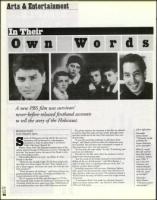
Left to right above:
Filmmaker
Joshua Greene:
"[Testimony] vividly
establishes the
human dimension
of the catastrophe."
Helen K, second
from left, with her
three little brothers
in Warsaw, Polanth
early 1930s. "I
was a very very
immature, very
sheltered little girl
And when the war
broke out, I grew
up overnight"
Filmmaker
Shiva Kumar:
"It became a project
about people."