
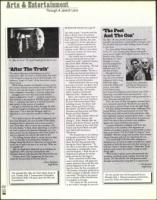

Photo cou rtesy of BETA- Fi lm
Through A Jewish Lens
In 'After the Truth," Dr. Jos ef
gets his day in court.
`After The Truth'
The ethical dilemma of defending pure evil is
explored in After the Truth, a German film that looks
at the fictional courtroom trial of Josef Mengele, the
infamous 'Angel of Death" of the Auschwitz concen-
tration camp.
While doing research on Mengele, young, success-
ful German attorney Peter Rohm receives a Nazi uni-
form in the mail that begins a chain of events that
lead to Mengele's surrender to German authorities.
Mengele, now in his 80s and cancer-stricken,
wants to defend his "work" -- medical experiments
that resulted in the deaths of 300,000 people, mostly
Jews -- saying he did them as a medical researcher
and entirely in the interest of mankind.
Mengele is defended by Rohm through the slow-
paced yet thought-provoking trial. Underlying ques-
tions arise: "Can a man like Mengele really be
defended in court and who would be willing to do
it?"
"It's a look at how in the world it happened, and
how Josef Mengele, the most horrible of the killers,
developed from a physician into a mass murderer,"
said Chris Riley, who co-wrote the screenplay with
his wife, Kathy "I think what's disturbing to people is
we tried to present the historical Mengele, not a car-
toon cutout, but the real person who could explain to
you in a rational way why he did what he di&
'It's chilling because there's a certain perverse logic
to it As horrible as his deeds were, Mengele is a
human being like all of us. That's not to excuse him
at all but to indict the rest of us, and say, `What are
we capable of?'"
After the Truth had a theatrical run in Germany in
September 1999, and was nominated for best
European feature at the Brussels Film Festival this year
German actor Gotz George- won the best actor
award for his portrayal of the Nazi doctor.
— Harry Kirsbaum
Staff Writer
The subtitled film After the Truth will be shown 8
p.m. Tuesday, May 2. Screenwriters Christopher
and Kathleen Riley will speak about the film and
its production.
4/21
2000
86
OF FAITH & FLICKS
from page 85
the older people. I recently took the
film to Brazil, where the primary
language is Portuguese, and watched
how, with some subtitles, the audi-
ence laughed in all the right places."
As festival planners searched for
this year's films, they previewed 50
separate works. When it came down
to the final number, the three were
in complete agreement.
"Our mission was to include films
that portrayed Jewish themes from
around the world," explained Chessler,
who found Shtick, Shmaltz and
Shtereotypes very entertaining. "We had
hard choices because there are so
many good films available. We have a
lot of films that haven't been shown in
the United States, and we've invited
directors and writers so that audiences
can interact with the filmmakers.
"Most festivals don't start out as big
as we have, and we're very glad to have
Daniel Petrie with us on opening day
to talk about his film, The Assistant,
which is based on the Bernard
Malamud novel," Chessler says.
Petrie, who worked many years to
get the rights to the novel, has direct-
ed many well-known feature films,
including Cocoon: The Return with
Jessica Tandy and Hume Cronyn,
Fort Apache, The Bronx with Paul
Newman and Resurrection with Ellen
Burstyn and Sam Shepard.
His TV credits include Inherit the
Wind with Jack Lemmon and
George C. Scott, Monday After the
Miracle with Roma Downey and Bill
Campbell, Seasons of Love with Peter
Strauss and Rachel Ward and Sybil
with Sally Field and Joanne
Woodward.
"The Assistant says to an audience
and people everywhere that there is
nobility in forgiveness," says Petrie
about the film that portrays Jews
during the Great Depression. "To
me, this is a story about a man who
committed an unforgivable crime
and was forgiven. I think the act of
forgiveness is salutary for the for-
givee and also for the forgiver."
Petrie, committed to films that
carry a moral stance, will speak and
answer questions about the film and
all that happened in the 30 years
since he wrote the first screenplay of
The Assistant, ultimately produced by
a film company in Canada, where he
was raised. The director has present-
ed it at dozens of film festivals from
Los Angeles to Chicago.
"The vehicle for this moral look
at the world is through the eyes of a
The film The Poet and the Con is a profound and
powerful memoir about a poet and his criminal uncle
who bonded with each other during a time of crisis
in their lives.
Two years before filming began in 1991, Eric
Trules, 41, a Los Angeles poet, dancer and perfor-
mance artist, fought off Hodgkin's disease while his
favorite uncle, Harvey
Rosenberg, 55, went
through a 12-step
recovery program for
drug and alcohol
addiction and a 38-
year life of crime.
Though Eric's can-
cer went into remis-
sion, his soul remained
malignant with a long-
held inner anger
David Trules, filmmaker,
toward his family and
and Harvey Rosenberg in
"The Poet and the Con."
society. And while
Uncle Harvey may
have beaten his addictions and criminal way of life —
becoming a successful crisis interventionist — he
skipped the recovery step about making amends for a
most abhorrent criminal deed.
Thus, the issue of their incomplete spiritual recov-
eries remained unresolved: Would the poet and the
con be given a second chance to do the right thing?
The pair, feeling somewhat cocky, challenged their
Jewish family's motives and sincerity at Eric's 44th
birthday party held around a back-yard picnic table.
Eric expressed romantic notions about crime — theo-
rizing that his 'outlaw" creative thrust as a poet and
clown was akin to his con uncles own rebellion
against the norms of family and society.
A spirited discussion unfolded, with Eric's late
mother Roz as the standout. Her digression on
whether criminality is genetic is as memorable a mono-
logue as Joe Pesci's "Do You Think I'm Funny?" from
Goodftllas. With her energy and sincerity, Eric's mother
silenced the poet and stole the stage from the con.
The second half of the film then undergoes a
shocking turn of events as reality overtakes art, expos-
ing flaws in both the poet and con's first attempts at
recovery. Given a "second chance," filmmaker Truks
and his uncle muster the tearful courage to make
things right.
What results is poetic justice that pummels the
emotions, touching cosmic realities, universal and
Jewish. The Poet and the Con will generate much
thought and discussion long after it is experience&
— David Sachs
Staff Writer
The Poet and the Con will be presented 8 p.m.
Monday, May 1. Director-producer-screenwriter-
poet Eric Trules will address the audience.