

r
"Yidl in the Middle"• Growing up Jewish in De'sMoines, Iowa.
L
SUZANNE CHESSLER
Special to the Jewish News
augh a little. Cry a little. Discover a
little. Discuss a little.
That's all on the program for the
second annual Lenore Marwil Jewish
Film Festival hosted April 30-May 7 by the
Jewish Community Center of Metropolitan
Detroit at the United Artists Theaters in
Commerce Township.
Thirteen films — and many of the filmmak-
ers — will be introduced throughout the week,
and there will be a segment aimed at family
viewing. Each presentation was planned to
address issues of importance to today's Jews.
"We wanted something of interest to every-
one in the community, and we've clustered
most of the films in a thematic way," says
David Magidson, festival director, who
arranged the program with co-chairs Mindy
Soble Kaufman and Mark Chessler.
"When it comes to where Jews live, for instance,
we look in Iowa (Yidl in the Middle) and China
(Round Eyes in the Middle K i ngdom) and find what
it takes to have a Jewish life in these places.
"When we look at businesses, we explore
how the Barbie Doll, developed by a Jewish
company, changed the way America felt about
women (Barbie Nation: An Unauthorized Tour)
and the work of Jewish diamond merchants
(Dealers Among Dealers).
"This isn't an educational festival. Although
it concentrates on a series of ideas, it's aimed at
giving audiences a good time."
Certainly a good time was the aim of
Murray Glass, the 30-year owner of a feature
film rental business asked to compile footage of
Suzanne Chessler is a Farmington Hills-based
freelance writer.
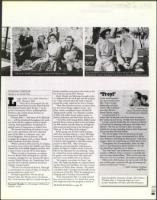
Kate Greenhouse and Gil Bellows in Daniel Petries "The Assistant."
The festival's "Main Attraction" is based on the Bernard Malamud novel.
Jewish comedians and present the results at the
San Francisco Jewish Film Festival.
Shtick, Shmaltz and Shtereotypes brought smiles
to California film fans of all ages and the word got
out. Glass, who has taken the work to festivals
around the world, makes his first visit to Detroit.
"Most film festivals are heavy on heavy films,
but this movie brings a lighter touch," says
Glass, whose compilation opens the festival.
"Being Jewish myself, I've collected a number
of films with either Jewish subject matter or
Jewish performers, and that's been fun for me.
"I have films with George Burns, Eddie Cantor
and Jack Benny. Some go back to the time before
the 20th century, into the silent era, through the
early sound era and end up in the television era.
There are 15 short films in the program."
Before going into the film rental business,
which has provided classics to many Michigan
institutions including the Detroit Institute of
Arts and the University of Michigan, Glass was
a chemist who happened to take film history
courses in New York. After moving to
California and pursuing film collecting as a
hobby, he began to market rentals to pay the
bills for the selections he was amassing. Soon,
he realized his money making potential would
be greater with movies than with chemicals,
and now counts 8,000 titles in his library.
"My program runs about two hours," says
Glass, who laughs the hardest at a segment featur-
ing Jack Benny and Mel Blanc, the voice of many
characters in Warner Bros. cartoons. "My session
is divided in half. I introduce the first half, and we
see that part of the film. While the projectionist is
changing reels, I introduce the second half.
"Since showing this film, I've really learned
how universal humor is. I've found that young
kids laugh and enjoy the program as much as
Vreyr
In the autobiographi-
cal, documentary-style
film Treyf Cynthia
Madansky and Alisa
Lebow offer a glimpse
into their life as a
Jewish lesbian couple.
Concerns such as "I
Atik.
"Treyf": Exploring the
nature of Jewish identity
in contemporary America.
worry that I'm the only one of my sisters to marry a
Jew" jump out as if to say, At least were both Jewish."
Living a secular Jewish life, the women are filmed
in Israel and at meetings with peers who share their
lifestyle. The two are viewed in their normalcy,
locked arm in arm, spending time in their home and
discussing their life with family.
The movie begins with the printed word treyf
flashed across the screen, accompanied by a dictio-
nary definition including the description: "unkosher,
impure, dirty, not conforming to Jewish dietary law."
Throughout the 54-minute film, there are refer-
ences to and discussions about whether or not the
two should eat food that is not kosher.
The word "treyf" also is bestowed on one who is an
outsider, is different. There is, however, a reminder that
there are many Jewish lesbians. "We're not the only ones.
There are a lot of us out there," the narrator announces.
Filled with subtle humor, the movie ends with the
two strolling past a painted wall sign advertising the
kosher manufacturer "Streits."
— Shelli Liebman Do? f nan
Staff Writer
Trey"; preceded by Generation Exodus, will be shown
Thursday, May 4. Screenings begins at 5 p.m.
Cynthia Madansky will lead a post-film discussion.
OF FAITH & FLICKS on page 86
4/21
2000
85