

t` tia
s*"
4:1
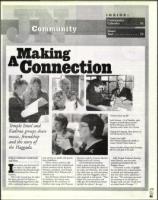
Clockwise from top left:
Jacki Herman, 13, of Franklin, right,
daughter of brotherhood president
Richard Herman, asks the Four
Questions with Cantor Lori Corrsin.
Temple Israel and
Kadima groups share
music, friendship
and the story of
the Haggada.
I
nteraction was the focus of
an April 13 model seder
hosted by the Temple Israel
Brotherhood for clients of
Kadima.
This is the second year the seder
has been planned for Kadima, a
Southfield-based organization that
offers residential options and sup-
port services to adults with psychi-
atric disabilities.
Thirty clients and five staff
members joined the brotherhood
board members led by Richard
Herman, president, and Temple
Israel Rabbis Paul Yedwab and
Harold Loss.
Geta Richman, clinical director
for Kadima, says clients were
delighted by the renditions of
familiar tunes sung with Passover-
Singing and clapping, Betty Spinner of
Oak Park joined in the fun.
Temple Israel staffer
Kari Provizer pnpares the candles as
Cantor Harold Orbach looks on.
themed words by Cantors Harold
Orbach and Lori Corrsin.
The brotherhood members
made a point of seeing that they
were disbursed among the clients at
the seder, says Richman, who noted
that tables were set with alternating
yellow and blue Haggadot, with a
color assigned to each group. "That
helped the communication and
really got the brotherhood interact-
ing\with the clients," she says.
Sally. Krugel, Kadima's develop-
ment director, says the seder
included participation by the
Kadima clients.
"The event is truly a highlight
for our clients, for it demonstrates
a warmth and welcoming spirit
that they don't often experience,"
she says. "The inclusion represents
the meaning of 'let all who are
hungry come and eat,' (and) there
are many kinds of hunger." ❑
IN
4/21
2000
41