

%NW
Question of the Week: Why is it that most Jews call this
holiday "Passover," not Pesach, while they refer to every other
Jewish holiday by its Hebrew name (no one says "Day of
Atonement" for Yom Kippur or "Head of the Year for Rosh
HaShana).
•moul ea lialcIdv 101 asoaid uaLiCAHAA of
so oGio! uo enoLi noA .UOSIDGJ inD-Joep ou s GJeLI ueA ► suv
14101110444 ,,
,
`%\''a.4tItctga.
Tales Of A
e
er
Why talking is such an important
part of the holiday.
in
0
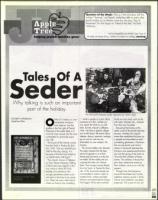
An old-world Passover seder depicted by Arthur Szyk.
ELIZABETH APPLEBAUM
AppleTree Editor
f the 613 mitzvot, or com-
mandments, that Jews
must observe, one that
applies to the first night of Pesach
(Passover) at the seder table is at
once the most unusual and the most
comfortable for practically every-
one: Talk.
The source of the mitzvah comes
from the Torah in Parshat Bo (Exo-
dus 13:8): "And you shall tell your
child on that day, saying, 'It is
because of this that God acted on
my behalf when I left Egypt."
This mitzvah, known in Hebrew
as Sipur Yetziat Mitzrayim ("Telling
of the Exodus from Egypt"), is the
only instance where the Torah
teaches us to reminisce with
younger generations about a piv-
otal event in the lives of our ances-
tors. There are many other mitzvot
where we have to say something
— recite a prayer or a text, inform
someone of a fact, confess our
sins, teach the Torah to our chil-
dren. But this mitzvah is different.
Here, we have a specific obliga-
tion to talk about, tell stories about,
debate, discuss, examine, analyze,
go on and on until we are
exhausted on one subject: the
Exodus.
The ancient rabbis who devised
the seder realized that the best
place for people to sit at their
leisure and converse is at the din-
ner table. Yet the rabbis did not
originate the idea of a Pesach
feast. That concept comes directly
from the Torah. In Parshat Bo (Exo-
dus 12:8), the Jewish people are
commanded to make a meal of
roasted lamb, matzot and bitter
herbs to commemorate the Exodus
from Egypt. All the extra symbolic
foods we now have, such as the
I salt water, charoset, etc., evolved
from that very first seder.
Discussing the Exodus at the
seder is part of the Jewish learning
I process, whereby the original
events that established the Jews as
a people are transmitted to each
succeeding generation. We know
that we are Jewish and what it
means to be Jewish because the
firstJews who experienced the Exo-
dus and the giving of the Torah at
Sinai told their children of those
events. The children of those first
Jews then related the events to
I their children, and so on until the
present.
Through time, the first-person
accounts have been lost, but the
I collective memory, found in Torah,
Talmud and midrashim, has been
preserved. This is part of why we
I
+3.
4/14
2000
141