

•
a movie together one day?'"
The old friends have at last ful-
filled their dream. Norton, now one
of the most acclaimed actors of his
generation, is directing and starring
in Blumberg's screenplay, Keeping the
Faith, about two old friends, a priest
and a rabbi who fall for the same
Irish-Catholic woman (Jenna
Elfman). Hip Rabbi Jake Schram
(Ben Stiller), who brings gospel
choirs and meditation to his Upper
West Side shul, is a "proxy" for
Blumberg, who like the protagonist
is charismatic and has had moments
of commitment-phobia.
The fictional priest, Brian Finn,
meanwhile, is not unlike Norton.
"There is a sweetness to the charac-
ter that reminds me of Ed,"
Blumberg says. And a certain metic-
ulousness, too.
Norton played Felix to Blumberg's
Oscar when the two shared apart-
ments in the East Village and Upper
West Side of Manhattan. "I'm much
cleaner now," insists Blumberg, who
turned 30 on the set along with
Norton. "But in those days, [Ed] used
to get mad at me for not cleaning up.
I'd have a lot of quarters lying around
Naomi Pfefferman is entertainment
editor at the Jewish Journal of Greater
Los Angeles.
for the laundry; he'd clean up
after me and he'd get so angry
that he'd take my quarters as,
like, a form of recompense."
Nevertheless, the two young
men worked as writing part-
ners for a time, collaborating
on, among other endeavors, an
evening of sketch comedy for
Off-Off-Broadway. "We wrote
a comedy script that, to this
day, we will never show any-
body," Blumberg confides.
Norton grew up in a privi-
leged, non-religious Christian
home in Columbia, *Md.,
where, he says, he was an "hon-
orary Jew." "If you go to more
than 10 bar mitzvahs, you get
an 'honorary Jew" certificate,
and I went to at least 10 the
year I was 13," he explains. "I
was drunk on Manischewitz for
half of 1983."
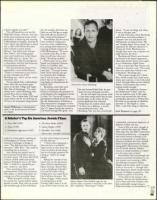
Screenwriter Stuart Blumberg
Blumberg, meanwhile, grew
up in a Conservative Jewish
like the fictional Rabbi Jake, he pon-
home in Cleveland, the grandson of
dered the issue of dating non-Jews.
avid Zionists who emigrated to Israel
On the one hand, his parents made
in their 70s. One set of his great-
it clear they would prefer that he date
grandparents helped found the Society Jewish girls; on the other, his first
for the Advancement of Judaism, a
serious girlfriend was a biracial
ReconstructiQnist synagogue in New
Presbyterian his mother doted upon.
York. The future screenwriter attended
"So there was a dialectic, a tension
the S.Y. Agnon Jewish day school in
surrounding the issue," says
Cleveland through fifth grade. And,
Blumberg, who now has a Jewish girl-
1. Frisco Kid (1979)
4. The Pawn Broker (1965)
2. Tevye (1939)
5. Liberty Heights (1999)
3. Gentleman's Agreement (1947)
6. Schindler List (1993)
— Sharon Rivo, Brandeis University
apply for artistic grants, opening up
the floodgates for diverse cinema,
marking a harbinger of things to
come. "You didn't just have to be an
American;" offers Rivo. "You could be
something else in America."
Also, during this period, one of
Rivo's favorite Jewish films came to
the silver screen: The Frisco Kid (1979)
is about a Polish rabbinical school
dropout finding his way in the Wild
West. "I think it's a wonderful por-
trait. I adore it," says Rivo.
Now, according to Rivo, Jewish
representations in film have entered a
third phase, in which filmmakers are
coming out of the proverbial closet.
"When Streisand, with her clout,
her money, her muscle and her talent,
decides to make Yentl, that's an incred-
ible breakthrough of Jews full-blown
on the screen being very proud
of who they are.
"I think what's happened is
that you have a wonderful
open society so that those who
want to portray Jewish charac-
ters are no longer penalized for
doing so. They're no longer
afraid."
Riding the coattails of this
third wave are the directorial
likes of Steven Spielberg and
Barry Levinson. Recent films
such as Spielberg's Schindle-rs
List and Levinson's Liberty
Heights have even made Rivo's
list of all-time favorites. The
Prince of Egypt, 1998's animat-
ed interpretation of the
Mama Kantor (Vera Gordon) urges her son
Exodus, didn't make it to the
(Gaston Glass) to become a musician in the silent
top of Rivo's short list but was film melodrama "Humoresque" (1920).
friend. "It was not black and white.
It was in the gray area."
At Yale University, where Blumberg
and Norton were both students, a
classmate who was half-Jewish and
half-Japanese introduced them. She _
was "straight-ahead, funny, sharp," an
inspiration for Elfman's character in
Keeping the Faith, Blumberg says,
though there never was a romantic tri-
angle between the three.
Blumberg and Norton soon became
fast friends in the theater department,
where they shared a funny scene togeth-
er in A Midsummer Night's Dream.
But it wasn't clear that Norton was
destined to become a star. "His acting
style is so subtle that I think it was
overlooked," Blumberg says.
"He is great onstage, but I think
film, which records such small move-
ments and nuances, is very well suited
to Ed. If people didn't see his [ability]
before, it was because they weren't
looking closely enough."
Norton, the unknown, became
the Hollywood "It Boy" after he
won an audition over 2,100 other
actors and secured the role of the
sociopathic altar boy in Primal Fear.
He went on to portray an idealistic
attorney in The People vs. Larry
Flynt, a neo-Nazi thug in American
LOVE TRIANGLE
on page 101
a watershed, mainstream depiction of
Judaism in films, she says.
Some of the new wave, though, is
more cultural than spiritual. Woody
Allen plays the neb, Billy Crystal plays
the Jewish professional — synagogues
and rituals remain as foreign a con-
cept as eating pork. In many films, a
character's Judaism has been chiseled
down to basic gastronomics, where
eating gefilte fish becomes the barom-
eter for Jewish identity. Judaism
remains a simple backdrop to whatev-
er is the main story at hand.
Nevertheless, Rivo increasingly sees
a positive portrayal of Judaism in cur-
rent cinema, even noticing a differ-
ence between Levinson's Liberty
Heights and his earlier work. It comes
across in the movie — through char-
acter depictions, Jewish rituals and the
concept of religion in general — that
Levinson is proud to be Jewish.
"If you look at the contrast," she
explains, "between the Jewish charac-
ters in Diner and what Levinson now
feels comfortable enough doing in
Hollywood today, it's extraordinary." [11
4/14
2000