

At The Movies
Ea
a*k
NAOMI PFEFFERMAN
Special to the Jewish News
tuart Blumberg
remembers the days
when he was a strug-
gling writer, rooming
in New York with his buddy,
Edward Norton, the strug-
gling actor. Every evening,
Blumberg arrived home late,
whereupon he and Norton
settled in front of the TV
with a couple of pizza slices.
0
0
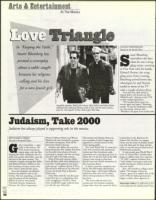
Interfaith relations: Rabbi Jake Schram (Ben Stiller) and Father Brian
Kilkenny Finn (Edward Norton), both in love with the same woman,
play the "God Squad" of New York's Upper West Side.
Over and over, they stared at
Raging Bull or the British cult film
Withnail and I playing on the VCR
in their modest apartment.
"We watched those same two
movies again and again," Blumberg
recalls. "It was like meditation while
we were eating. And we said,
`Wouldn't it be great if we could make
Judaism, Take 2000
Judaism has always played a supporting role in the movies.
a
BENYAMIN COHEN
Special to the Jewish News
od is everywhere — espe-
cially in the movies. His
most recent incarnation
comes today with the film
Keeping the Faith, telling the tale of a
rabbi and a priest who duke it out for
the love of the same woman. The
romantic comedy, starring Ben Stiller
and Edward Norton, follows in the
holy footsteps of many movies that
have tried- to tackle Jewish issues.
Since the inception of celluloid,
Judaism has played a role in the
movies. Not too surprising, consider-
ing that almost all the founding
fathers of cinema were Jewish.
Universal Pictures, Paramount
Pictures, Fox Film Corporation,
.4/14
2000
98
Metro-Goldwyn-Mayer and Warner
Brothers all were founded by a group
of Jewish immigrants, fresh off the
boat from Eastern Europe.
Scholars who follow the way Jews
are portrayed in film explain that there
are basically three phases of Jewish
portrayal in cinema, the first covering
the first half of the 20th century.
Most of the early movies, which
were all silent, dealt with Judaism in a
way that "could appeal to any immi-
grant group," explains Sharon P. Rivo,
the executive director of the National
Center for Jewish Film at Brandeis
University.
Early films made by non-Jews por-
trayed the Jew as a sympathetic char-
acter struggling in America. There
were wonderful images made by Jews
as well, she says. Films like
Humoresque and Hungry Hearts are
two examples of silent images that
appealed to a broad section of the
movie-going public.
But, until World War II, most Jews
who were involved with mainstream
culture put their Jewishness aside,
sometimes even running away from it.
Many Jews in the first half of the 20th
century were trying to shed their
Jewish roots and retrofit themselves to
the American dream.
A classic cinematic example is one
of the first full-length talking films,
The Jazz Singer, which had a different
resolution than some of the earlier
silent works produced in New York,
says Rivo.
The movie tells the story of a
young man who became a popular
singer rather than the cantor his father
wanted him to be. Based on Al
Jolson's life, the film, in a deeper
sense, was the story of children break-
ing with their past for fame and for-
tune. It was the story of almost all of
Hollywood's patriarchs.
In the second, post-World War II
wave of "Jewish film", Jewish artists
began to address their own concerns.
"In 1960," explains Professor Rivo,
"with Exodus, you've got a real, won-
derful coming out of Jews proud of
the new Israeli."
Rivo, who teaches a college course
called "The Images of Jews on
Screen," goes on to explain that in the-
mid-1970s the federal government
began to allow ethnic agencies to
Benyamin Cohen is a sta writer at our
sister publication the Atlanta Jewish Times.