

as
WHAT ARE THE DEAD SEA SCROLLS?
The Dead Sea Scrolls were written in Hebrew,
Aramaic and Greek over a period of three centuries,
from about 250 B.C.E. to about 70 C.E. The first
scroll fragments were discovered in 1947 by a
Bedouin shepherd looking for his lost goat in a cave.
Over the following decade, more than 100,000 frag-
ments, representing as many as 800 individual com-
positions, were found in a series of 11 caves in the
Qumran region of the Judean Desert.
In addition to the actual scroll fragments and their
English translations, the exhibition includes 80 arti-
facts from Qumran. Among them are coins, goblets,
sandals, a scroll storage jar and a pottery inkwell that
may be connected with the writing of the scrolls.
Scholars continue to debate the relationship
between the scrolls and the people of Qumran,
whose settlement was destroyed by the Romans
around 68 C.E., near the time when the last scrolls
are believed to have been written.
Not all of the Dead Sea Scrolls are books from the
Hebrew Bible. The ancient manuscripts also contain
apocryphal books found in the Christian and Greek
Bibles (those books not included in the Hebrew Bible)
and sectarian doaiments related to the people who are
associated with the scrolls, such as community laws.
Four of the five scrolls making their public debut
at the Field Museum are believed by some scholars
to contain ideas and language similar to that found
in the New Testament. A messianic apocalypse refers
to the raising of the dead. Others include the "Son
of God" fragment, an Aramaic apocalypse similar
to passages from the Book of Luke; a scroll in
which the repeated use of the word "blessed"
recalls language found in the Gospels Beatitudes;
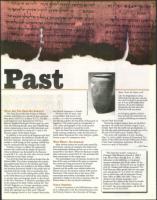
Above: From the Psalms scroll.
and several fragments in Greek.
For more than 40 years, only
seven scholars had access to the
scrolls— to work on translating
and piecing together the hundreds of thousands of
fragments. The project sped up considerably in
1991, when photographs of the scrolls became
available to researchers around the world.
Now the Dead Sea Scrolls Publication Project is
finally nearing completion under the direction of
Israeli editor Emmanuel Tov, who will give a public
lecture as part of a symposium series.
WHO WROIT THE SCROLLS?
Most scholars believe the scrolls were created by
the Essenes, a group of sectarians who broke away
from mainstream Judaism and set out to live a com-
munal life in the desert. When the Romans invaded
their community around 68 C.E., the sectarians hid
their manuscripts in the nearby caves.
The archeological ruins of Qumran, located at the
base of the caves, are believed by many to represent
the communal living structures of the Essenes.
Despite the probable connections between
Qumran and the scrolls, some scholars believe the
Essenes were not the exclusive authors of the ancient
documents. They assume that at least some of the
manuscripts were written in Jerusalem (and later
deposited or hidden in the caves at Qumran when the
Roman threat to that city became imminent).
PUBLIC: SYMPOSIA
A series of symposia at the Field Museum, creat-
ed in collaboration with the Oriental Institute and
the Divinity School at the University of Chicago,
An elongated piece with a
ri bed body and ring base, this vase
has a short neck that is turned inside
out. It is one of 80 artifacts from
Qumran, the ancient settlement
located near the caves where the
Dead Sea Scrolls were found
are bringing together scholars
from around the world who are
actively publishing and research-
ing the Dead Sea Scrolls.
Upcoming weekend sessions focus on the follow-
ing topics: the scrolls and Christian origins (2 p.m.
Sunday, April 16); the scrolls and apocalypticism, or
the idea that good will ultimately triumph over evil at
the end of the world (2 p.m. Sunday, May 7).
The series will conclude at 2 p.m. Sunday,
May 14, with a public lecture by Emmanuel Tov,
editor of the Dead Sea Scrolls Publication Project
of the Israel Antiquities Authority. All of the
events are open to the public.
— JNF News
"The Dead Sea Scrolls" continues at
Chicago's Field Museum, located at 1400 S.
Lake Shore Drive, through June 11, 2000.
Admission to the exhibition is the general
museum admission plus $3 for adults; $2 for
children ages 3-11, seniors 65 and up, students
with ID, teachers and military personnel. The
Field Museum offers special rates for tour oper-
ators and groups of 15 or more. For informa-
tion on these rates, call the museum's Group
Sales Office at (888) 343 - 5385. There is no
charge for the closing symposium with
Emmanuel Tov, editor of the Dead Sea Scrolls .
Publication Project. (The other symposia are
$12 each). For more information, call the Field
Museum at (312) 922-9410.