

dert b inment
Have
your party
at
The Scrolls' Significance
A treasure trove of original documents opens new vistas
of Jewish history, Bible and scholarship.
HERSHEL SHANKS
The JUF News
T
The
Perfect Place
for
*Bridal Showers
*Baby Showers
I-Retirement
3-Office Parties
*-All Special Occasions
Customized Menus
Southfield:
248-351-2925
29244 Northwestern Hwy.
St. Clair Shores:
810-498-3000
23722 Jefferson at Nine Mile
Detroit:
313-965-4600
400 Monroe in Greektown
111111111141111L11411111iiii
Need a
New
Coat?
4/7
2000
100
Check out the
Painters and
Wallpaper
Hangers
in our
Marketplace
Home and
Service Guide.
1
he Dead Sea Scrolls have
been called the greatest
archaeological find of the
20th century. And so far in
the 21st century, nothing has sur-
passed them.
Yet, while everyone has heard of the
Dead Sea Scrolls, almost no one —
apart from a few scholars — can tell
you what they say. What is so extraor-
dinary about them? What do they tell
us that we didn't know before?
Indeed, most people don't even
know what they are. How many of
them are there? In what language were
they written? Who wrote them?
While there are more than 800 of
the scrolls, fewer than a dozen can be
called in any sense intact. The rest are
mere scraps — like a crossword puzzle
with 90 percent of the pieces missing.
About 600 are in Hebrew and the rest
in Aramaic (with a few little pieces in
Greek). About 200 are parts of books
that eventually made their way into
the Hebrew Bible.
I say "eventually," because this was
before the Bible was the Bible. The
books of the Bible had not yet been
canonized. Indeed, the text of the books
had not yet been standardized. The
scrolls sometimes include more than
one edition of some books of the Bible.
One edition of Jeremiah, for example, is
20 percent longer than another one.
Most scholars believe the scrolls
were the library of a sect of Jews called
Essenes. But this is not certain.
Many factors point in this direc-
tion, but others make some scholars
wonder. The scrolls themselves do not
tell us who wrote them. The word
"Essene" does not appear in them. A
settlement called Qumran, near the 11
caves where the scrolls were found, is
thought to be where the Essenes lived.
But this, too, is hotly disputed.
The extensive architectural remains
'•
Hershel Shanks is editor of "Biblical
Archaeology Review" and author of
"The Mystery and Meaning of the
Dead Sea Scrolls" (Random House).
FVP ;
ti:to
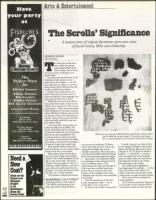
While there are more than 800 Dead Sea Scrolls, fewer than a dozen
can be called in any sense intact. The rest are mere scraps —
like a crossword puzzle with 90 percent of the pieces missing.
are not easy to understand. Whoever
wrote the scrolls, however, did not get
along with the folks who ran the
Temple in Jerusalem. Worse than that,
the Qumranites didn't think the Temple
Jews were practicing authentic Judaism.
Qumranites even followed a differ-
ent calendar, so they observed the fes-
tivals at different times. (The
Qumranites also had some festivals of
their own that we didn't previously
know about.) And they were even
stricter in their religious laws (their
Halacha) than the Jews who controlled
the Temple.
Kind of reminds you of the divi-
sions among Jews today — but in
those days it was much worse.
So why are the scrolls so important?
Overall, they give us a direct look
at the religious thought of the period
before the Roman destruction of the
Temple in 70 C.E. But if a scholar's
subject — in any field — concerns
this time period (or a few hundred
years on either side), he must look at
the Dead Sea Scrolls to see if they
have bearing on the subject.
The scrolls' greater significance —
just beginning to be explored — is what
they tell us about other subjects. In
other words, they must be seen as part
of the answer to larger scholarly puzzles.
Three such areas are perhaps the
most significant.
The scrolls are extremely important
in the study of what scholars call his-
torical Jesus studies and the develop-