

Whose Jerusalem?
DIVIDED CITY
from page
9
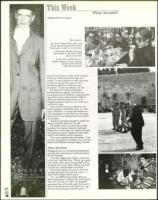
Top to bottom:
Over lunch: Faigie Kreger, right, with
friends Shulamit Rosenweld and Dov
Rosenwald at a cafe in west Jerusalem.
A Palestinian Moslem walks near
Israeli soldiers in the Western Wall
plaza in Jerusalem.
A nun waits as Shiban Amer, a
Moslem shopowner in the Christian
Quarter of the Old City,
talks about Jerusalem.
level of services given to the Jewish residents
of the city. Israeli authorities stage "tax
sweeps" in east Jerusalem to make sure shop
owners are paying their taxes, he said —
something which is not done in west
Jerusalem. "It's like an ambush," he said.
The litany of complaints Palestinian
Jerusalemites have against the Jewish-run
municipality include difficulty in getting build-
ing permits and revoking residency rights if
they move elsewhere because there is not
enough housing or if they are out of the coun-
try for over a year.
These conditions are not placed on the
Jewish residents, said Shiban Amer (no rela-
tion to William), a 45-year-old Muslim sou-
venir shopkeeper in the Old City who spent
several years in an Israeli prison for his politi-
cal activities.
"Israelis say Jerusalem should be united, but
there is no justice here now," he said.
His brother Amin, 42, noted that outside
Jerusalem the situation between Israelis and
Palestinians is more open. For instance, he said,
Israeli groups come to "laugh and enjoy them-
selves" at his family's Jericho restaurant.
He is more optimistic than his brother. "I am
sure this can happen in Jerusalem, too. I am sure
Israelis and Palestinians can get along," he said.
Heart And Home
WEST MAPLE
'VVN BIRMINGHAM'
48.258.0212
JN
3/24
2000
10
Feelings for the city run deep for Jerusalemites
on both sides and everyone is hunkering down
for the long haul.
"I am not religious, but I have a connection
to this city," said Yael Ohry. "This is my capital.
I am ready to give up my arm and half my leg
for peace, but not my heart. Without my heart
I cannot live, and Jerusalem is my heart."
In the final analysis, she said, it will be the
younger generation that will make peace —
and in the end there will be peace.
"It is very difficult for someone from my
father's generation to believe there will be peace,
but I do," she said. "It will be my daughter's
generation that will actually make that peace. A
person who has lived war will think war; a per-
son who has lived peace will think peace." ❑
tea
,a tIVV VV ? ,,1 '"&;;;*,‘ ,.
•
:5