

Arts 15 Entertainment
la
U
MARA DRESNER
Special to the Jewish News
nick! What rhymes with
orange?
Before you rack your
brain too long, the answer
is nothing — "unless you count door
hinge," notes Hilary B. Price, the
red-headed cartoonist of the syndi-
cated comic strip Rhymes with
Orange. The strip appears weekly in
the Detroit Free Press Sunday comics.
"I chose the title because I feel
the strip represents the viewpoint of
a young woman and her friends,
who are generally not represented in
the comic pages," Price adds.
Rhymes with Orange provides
quirky, unconventional reflections
on life. The strip has addressed
everything from "Cows on Ellis
Island" to "If Cats Wrote Greeting
Cards" to "How to Treat Jerks: A
Receptionist's Guide."
Price, who works out of a studio
in a converted factory building in
Florence, Mass., says she "always had
an interest in art. I remember liking
TtE
VERy
RACY
ACT
eltRITTM AS
EV E
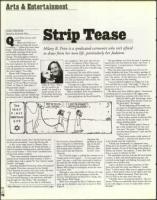
Hilary B. Price is a syndicated cartoonist who isn't afraid
to draw from her own life, particularly her Judaism.
Hilary B. Price: "Where
do I see myself in the
world? I see myself as a
Jewish woman; it's one
of the things that's going
to inform my humor"
Lc i<6 EATINS?
Mara Dresner writes for the Connecticut Jewish Ledger.
78
one complains, "You never take me any-
where." An admirer of Roz Chast and
other cartoonists at the New Yorker, Price
sent her cartoon off to the venerable mag-
azine, which rejected it.
Undaunted, she took off for Ireland,
where she discovered a political magazine
that published cartoons. The magazine
not only purchased the fish cartoon, but
several others as well.
"It bought me a plane ticket to Paris.
From that time on, I'd keep a journal in my
backpack to write down ideas," Price says.
Back at Stanford, Price was published in
the university's feminist journal.
Upon graduation, she found herself in
MAT DC Yet FEEL.
cartoons and art classes. But I haven't had my eyes
on the prize constantly," notes the 30-year-old.
In fact, at her high school in Weston, Mass. —
where her father worked in the family business, a
chain of women's clothing stores, and her mother
was a social worker — Price wasn't considered one
of the more artistic students.
"There were extremely talented artistic people. I
played soccer instead and took ceramics. I knew I
couldn't draw with a capital 'ID,' but I knew I could
doodle," she laughs.
Attending Stanford University, where she majored
in English, Price drew cartoons for her friends.
Then, between her junior and senior years, she took
a year off and lived on Martha's Vineyard.
"It was a foolish fantasy; I always wanted to write.
I found myself freezing in my apartment and look-
ing through the New Yorker," she remembers.
Price drew a cartoon of two fish in a fish bowl;
3/3
2000
Tease
San Francisco, doing freelance
copy writing for an advertising
agency while drawing cartoons
and sending them to publica-
tions such as the San FranciscO
Christmas Eve
offWebsite: Price's
take on the first
Christmas Eve,
from her "How
are Jew?" series.
Chronicle.
The Chronicle began to publish her cartoons in its
Sunday book review section — "It was a great moti-
vator," she says — and Price continued to send out
her material. She finally received a call from King
Features, the large comics syndicate that debuted
Rhymes With Orange in newspapers across the coun-
try in June 1995.
Although it runs only weekly in Detroit, the strip
appears daily in about 80 newspapers across the
country. Selected strips are featured in a book, also
titled Rhymes With Orange.
While Price enjoyed her life in California, three
years ago she decided it was time to return to New
England.
"My grandfather was 94 at the time. I wanted to
spend time with him before he died," says Price. "I
wanted green, I wanted seasons. I wanted snow
more than anything."
What she didn't particularly yearn for are the
weekly deadlines she faces. Price sends a package of
cartoons off each Friday afternoon. "Sometimes, I'm
late," she admits. "In the afternoons, I'm most cre-
ative. I futz around in the morning.
"I never pulled all-nighters in college, but I do
now and that has to stop," she laughs. "I often do
cartoons at 2 or 3 in the morning. The deadline
forces you to do it."
Her ideas come from different places. "Sometimes
something said in conversation will trigger some-
thing else. Sometimes, someone will e-mail me [an
idea] and that's a gift. Sometimes, some-
thing just drops from the sky. Those are
the good days," she laughs.
"At the beginning of the week, you
can hear me complaining that I'll never
be able to come up with another car-
toon; I've run dry. At the end of the
week, I've done seven," she adds.
Price works a month in advance (five
weeks for the Sunday strips), so she's
always thinking ahead.
"With the holiday strips, I have to
get in the mindset early or wait until
next year," she notes. "I already have
one idea about Passover; I can't wait for
April to use it."
Price's strip covers a wide variety of
material — and she isn't afraid to turn
to her Jewish roots for inspiration.
"I think [my Jewishness] is a placement issue.
Where do I see myself in the world? I see myself as a
Jewish woman; it's one of the things that's going to
inform my humor," she explains. "I don't deal with
this as a cause. It informs my life."
She remembers the first strip she did with Jewish
content. It dealt with Jewish gardening tips, and
involved eating bagels and shaking the poppy seed
crumbs into a window box.
"I got a call from my editor's assistant in New
York, who said [the strip] was offensive," recalls
Price. "I said it wasn't; there was no negative conno-
tation. I think there's a fear on the editor's part that
I'm going to offend [someone]. That's how they
have to look at the strip; that's their job.
"I feel like this is my personal opinion," she con-
tinues.''Editors are squirrelly about humor that has
to do with religion or race. It makes them uncom-
fortable."