
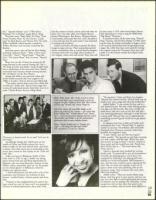

Photo cou rtesy of Showtime Archives
Me," "Spanish Harlem" and "I (Who Have
Nothing)" for ex-Drifters' singer Ben E. King.
They also wrote "Ruby Baby" for Dion, "Love
Potion Number Nine" for the Clovers, "Lucky
Lips" for Ruth Brown and "Kansas City" for Little
Willie Littlefield (which became a smash for
Wilbert Harrison and was later covered by the
Beatles).
And they wrote a slew of hits for Elvis Presley,
including "Jailhouse Rock," "Baby, I Don't Care,"
"Love Me," "Don't," "King Creole," "Treat Me
Nice" "His Latest Flame" and, of course, "Hound
Dog."
Many, but not all, of those are among the 38
songs featured in the musical Smokey Joe's Cafe —
The Songs of Leiber and Stoller. Gladys Knight head-
lines a production of the seven-time Tony Award-
nominated and Grammy Award-winning musical
Feb. 29-March 5 at the Fox Theatre.
Smokey Joe's follows two previous Leiber and
Stoller-fueled musicals that were staged in the
1980s in London, Only in America and Yakety Yak.
"The earlier versions had a story line, which did-
n't hold up," Stoller said. "Because the songs were
written for individual records. And when you try to
make 'Charlie Brown' the son of Big Mama
had this interest in black culture and loved what we
knew of it. Our early idols were Charles Brown,
Jimmy Witherspoon, Roy Brown, Wynonie Harris,
Louis Jordan and people like that. And I decided at
a very early age that the only music I was interested
in writing was the blues."
Leiber and Stoller still share a passion for blues,
boogie-woogie and jazz. Their partnership ignited
almost immediately after a mutual friend arranged a
meeting while both were high school students in
Los Angeles, where each had moved. They were still
in their teens in 1951 when band leader Johnny
Otis asked them to write a song for Willie Mae
"Big Mama" Thornton.
A sanitized version of the same song, "Hound
Dog," became a hit for Elvis Presley in 1956, open-
ing the door for Leiber and Stoller to begin a lucra-
tive musical relationship with the gyrating young
singer. Yet, while they were never paid for writing
the original version for Thornton, both men still
prefer it to the Presley remake that helped make
them rich.
ove: Mike Stoller, Elvis Presleyand Jerry Lieber:
Lieber and Stoller were commissioned to write the
sang for the film 7ailhouse Rock" after Elvis' version
their song "Hound Dog" scored a huge hit.
"No question," Leiber said from Los Angeles.
"Because her version is better. 'Hound Dog' was tai-
lored to her voice, range and what she looked like."
Added Stoller: "It was written for her, and in a
way inspired by her. She was a salty-looking person,
very big, over 200 pounds. She wore overalls and
work boots, had razor scars on her face and had a
very menacing demeanor, although in truth she was
a cream puff 'Hound Dog' was a euphemism for
something we both figured would never get played
on radio."
In separate interviews, Leiber and Stoller each
maintained they wrote "Hound Dog" in approxi-
mately 12 minutes. Nevertheless, they were both
dismayed when Thornton crooned, rather than
growled, the suggestive . song.
"I said, 'Mama, that ain't the way it goes,'"
Leiber recalled. "She ignored me and kept crooning,
so I said it again. And she said, 'White boy, don't
tell me how to sing no blues!' I think I could have
been purple and she would have said, 'Purple boy,
don't tell me how to ...' The main thrust was:
`Don't tell me.'"
Asked to describe their method for writing,
Stoller said, "It started off as sort of simultaneous.
I would start playing piano, and if Jerry was
intrigued by anything I was playing he'd start
yelling out words and phrases. We'd hammer it
out, note-by-note, word-by-word, arguing all the
time. But we wrote very quickly. Later on we
spent a little more time polishing, like on the
Coasters' songs. And we always edit each other.
We're like brothers."
Added Leiber: "There are certain classic song
forms. And they grow in your psyche, and you can
just turn your light on and superimpose the content
of whatever you are dealing with [lyrically]. I think
songwriters rely on that; then they paint in the
squares or numbers. But it's much more difficult to
Lieber, left, and Mike Stoller, at the
tam a r ejoined by the Coasters — for whom they
0?-ate "Yakety Yak," "Charlie Brown" and "Poison
and executives from Atlantic Records, which
ed Lkber and Stoller to the first independent
production deal in music-industry history.
Below: Gladys Knight stars in "Smokey Joe's
e -- The Songs of Lieber and Stoller"
. 29-March 5 at the Fox Theatre.
Thornton, it doesn't work. So we said, 'Let's just do
the songs.'"
Accordingly, Smokey Joe's Café focuses on the
wealth of Leiber and Stoller-written hits, but it
sheds no light on the men behind them. And that's -
a shame, since their stories are as memorable as the -
music they created in their heyday in the 1950s and
early '60s.
Leiber was born in Baltimore, Stoller in New
York, both in 1933. At age 7, Stoller was taking
piano lessons from jazz and blues legend James P.
Johnson, who was more famously a mentor to Fats
Waller. Leiber, meanwhile, grew up "on the periph-
ery of a black ghetto" in Baltimore, where his
mother ran a grocery store.
"I delivered kerosene and soft coal to a lot of her
customers, and I became very welcome in their
homes," recalled Leiber, a former pianist and drum-
mer.
"Nobody in that neighborhood was used to hav-
ing a white boy wait on them, and I was exposed to
all sorts of cultural phenomena, Jerry . and I both
IN
2/25
2000
75