

Arts Entertainment
st 11 & n o 111119
*
'14‘
\\\s%,
Z,40t
•
"Smokey Joe's Cafe" celebrates the music
of Jerry Lieber and Mike Stoller.
GEORGE VARGA
Copley News Service
ould two Jewish boys thrive writing classic
songs for black blues and R&B artists in
the largely segregated United States of the
early 1950s?
Jerry Leiber and Mike Stoller didn't stop to pon-
der such a question when they teamed in Los
Angeles 50 years ago. They were too busy pursuing
their shared aural vision to consider the odds of
such a seemingly improbable task.
At least in this case, though, truth proved
stranger and better than fiction. With the speed of a
hound dog racing through a patch of poison ivy, the
dynamic young duo succeeded beyond their wildest
dreams.
Only 17 when they began collaborating in 1950,
the two went on to write some of the hippest, most
vibrant songs in the lexicon of African American
music. And they did so at a time when the unfortu-
nate social and cultural barriers between most blacks
and whites made Leiber and Stoller's success even
more unlikely than Pat Boone achieving fame with
white-bread versions of songs by Little Richard and
Fats Domino.
"When we had our first hits, none of the white
kids we knew ever heard of them," Stoller, 66,
recalled from his Los Angeles office.
"Like 'Hound Dog,' which we wrote for Big
Mama Thornton. It sold almost a million copies. It
was No. 1 in most black communities for 13 to 14
consecutive weeks, and all the black people we knew
were familiar with it. But it wasn't played on [white]
pop radio, only on the 'race music' stations that
catered to a black audience and advertised products
geared to a strictly African American audience."
The other classics that Leiber (the lyricist) and
Stoller (the composer) went on to write could fill a
CD box set. Their rich repertoire also ensured their
place in the Rock and Roll Hall of Fame, which
inducted them in 1987.
A sampling of the songs they wrote includes:
"Riot in Cell Block No. 9," "Framed" and "Smokey
Joe's Cafe" for the Robins; "Yakety Yak," "Young
Blood," "Charlie Brown" and "Poison Ivy" for the
Coasters (as the Robins were renamed in 1955);
"On Broadway," "Dance With Me" and "There
Goes My Baby" for the Drifters; and "Stand by
C
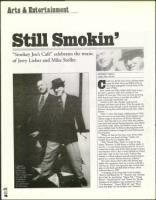
Composer
Mike .Stoller
and lyricist
Jerry Lieber:
Their compositions
provided the
soundtrack
to the lives
of a generation
ofAmericans.
2/25
2000
74 .